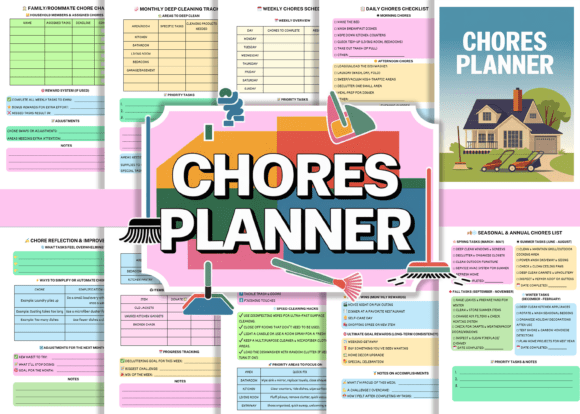
Chores Planner - KDP Template
The Chores Planner - KDP Template is a downloadable 120-page PDF designed for household management. It includes structured worksheets and editable Canva pages intended for printing or digital use. Created for self-publishing on Amazon KDP, it serves as a ready-to-use planning tool—not software, not an app, but a printable, customizable workbook format.
People often seek tools like the Chores Planner - KDP Template when household responsibilities feel scattered or inconsistent. This may happen after moving in with roommates, starting a family, managing a multi-person household, or simply noticing recurring tasks slipping through the cracks. Unlike generic to-do lists, this planner organizes chores across multiple timeframes—daily, weekly, monthly, seasonal—and by location, person, and priority.
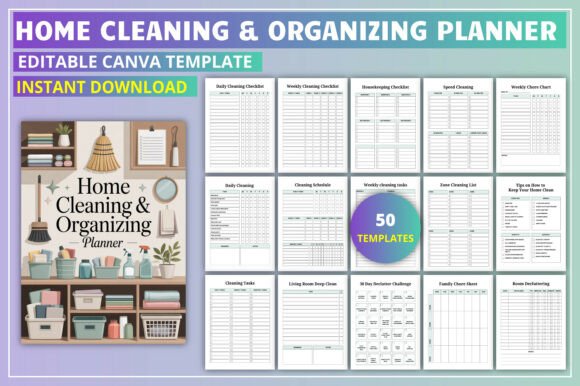
Its structure supports several practical needs: assigning responsibility clearly, reducing repeated conversations about who handles what, tracking completion without relying on memory, and planning ahead for less frequent but important maintenance. For example, the Seasonal Annual Chores List helps schedule HVAC filter changes or gutter cleaning before problems arise, while the Emergency Cleaning Plan offers a realistic 30-minute checklist—not an idealized version—for unexpected guests.
One benefit of the Chores Planner - KDP Template is its balance of flexibility and guidance. The Daily Chores Checklist separates tasks into morning, afternoon, and evening slots—not to enforce rigidity, but to reflect natural energy rhythms and household flow. Similarly, the Room-Specific Cleaning Tracker allows users to monitor progress by area (e.g., kitchen, bathroom, living room), making it easier to identify which zones need more attention over time.
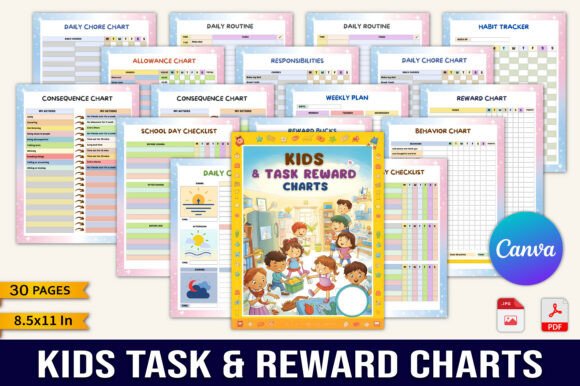
The inclusion of a Chore Rewards Motivation section acknowledges that consistency depends on more than structure—it also relies on reinforcement. This isn’t gamified in a digital sense, but provides space to define simple, meaningful incentives (e.g., shared takeout night, extra screen time, small treats) tied to completed cycles. Likewise, the Decluttering Organization Log supports longer-term goals by separating “areas to organize” from “items to donate or sell,” helping avoid overwhelm during spring cleaning or downsizing efforts.
However, the Chores Planner - KDP Template has clear tradeoffs. Because it’s a static PDF, it doesn’t auto-sync across devices, send reminders, or update based on completion status. Users must manually check off items, transfer data between pages, or reprint sections as needed. Those accustomed to digital task managers (like Todoist or Google Tasks) may find the lack of automation limiting—especially if household members aren’t all comfortable with printed tools or consistent handwriting.
Another consideration is customization scope. While 12 Canva-editable pages are included, most of the planner remains fixed in layout and content. You can adjust names, dates, or checkboxes—but not core categories, page order, or underlying logic. If your household requires highly specialized tracking (e.g., pet care schedules alongside chores, or integration with meal planning), you’ll likely need to supplement with additional tools or manual adaptations.
Print quality and usability also depend on user setup. The planner uses standard 8.5 × 11" dimensions, but effectiveness hinges on how it’s used: bound in a notebook, placed in a binder with dividers, or printed selectively. Some users report better results when printing only active sections (e.g., weekly charts) and reusing them weekly, rather than filling out every page at once.
The Chores Planner - KDP Template tends to be a strong fit for households that value tactile engagement, prefer low-tech solutions, or have inconsistent internet access or device sharing. It works well for families with children who benefit from visual, hands-on responsibility tracking—or for roommates who want transparency without relying on group chats or overlapping calendar invites. It’s also suitable for individuals managing homes alone who want to move beyond mental lists and build sustainable routines.
Conversely, alternatives may be preferable in certain situations. For households where members use different devices throughout the day, cloud-based shared planners (such as Tody, Sweepy, or even a shared Notion dashboard) offer real-time updates and notifications. For those already using digital ecosystems like Apple Reminders or Microsoft To Do, integrating chore assignments there may reduce friction. And for people needing accessibility features—text-to-speech, high-contrast mode, or keyboard navigation—a static PDF won’t meet those needs without third-party assistance.
Cost and long-term utility are also worth weighing. As a one-time purchase, the Chores Planner - KDP Template avoids subscription fees. But because it’s not updated regularly, users bear responsibility for adapting it over time—for instance, revising seasonal tasks as home systems age or family needs shift. There’s no built-in guidance on how to revise or scale the system, so ongoing effectiveness depends on user initiative.
When evaluating whether this planner aligns with your goals, ask: Do you prefer writing by hand or typing? Is consistency more valuable than convenience—or vice versa? How many people need to access or update the plan simultaneously? If the answer leans toward handwriting, shared physical visibility (e.g., on a fridge or bulletin board), and predictable, repeatable structures, the Chores Planner - KDP Template offers a grounded, no-frills approach.
It’s also helpful to consider implementation effort. Starting small—using just the Weekly Chores Schedule and Family Roommate Chore Chart for one month—can reveal whether the format fits your communication style and accountability preferences. If those two sections support clearer delegation and fewer follow-up questions, expanding to deeper tracking (like the Monthly Deep Cleaning Tracker) becomes more meaningful.
Finally, recognize that no single tool eliminates the work of coordination—it reduces friction. The Chores Planner - KDP Template provides scaffolding, not automation. Its value emerges not from complexity, but from clarity: naming tasks, assigning ownership, setting timing, and recording progress in ways that match how your household actually operates—not how productivity theory says it should.