My Baby’s First Quest Milestone Tracker: A Fantasy-Inspired Alternative for Mindful Parenting
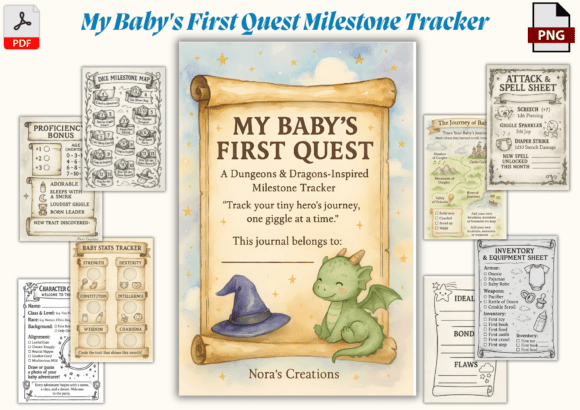
My Baby’s First Quest Milestone Tracker is a printable, 6x9-inch, 14-page PDF (with PNG options) designed to document a baby’s first year through the imaginative lens of tabletop role-playing—specifically drawing from the structure and charm of Dungeons & Dragons. It’s not a digital app or a physical hardcover journal, but a thoughtfully themed, low-friction printable resource that invites intentionality without demanding perfection. Unlike generic baby journals, it replaces checkboxes with character sheets, growth charts with “Baby Stats,” and developmental milestones with whimsical “adventures” like “First Giggles (1d6 Sparkle Damage)” or “Diaper Strike (Critical Success on Roll).” This isn’t just novelty—it’s a framework that reshapes how parents observe, reflect on, and emotionally engage with early development.
How It Differs From Traditional Milestone Trackers
Most milestone trackers prioritize clinical clarity: standardized checklists aligned with CDC or AAP guidelines, chronological grids, photo placeholders, and medical or motor-skill categories. My Baby’s First Quest Milestone Tracker departs intentionally. Its “Character Creation Sheet” asks for baby’s name, “class” (e.g., “Chaos Sorcerer” or “Peaceful Druid”), “race” (e.g., “Human (Standard Edition)” or “Half-Elf (Nap-Resistant Variant)”), and “alignment”—a lighthearted prompt that encourages reflection on temperament rather than diagnosis. “Strength” might log head control or tummy time endurance; “Charisma” captures social smiles or vocal play. The emphasis is interpretive, relational, and narrative—not diagnostic or comparative.
This approach serves a specific need: reducing parental anxiety around timing. When a milestone appears as “+2 Proficiency Bonus at 4 Months (if nap schedule stabilizes),” it subtly reinforces variability and context—no pass/fail framing, no implied urgency. In contrast, many digital trackers auto-flag delays based on rigid age windows, which can trigger unnecessary worry even when development is on track. My Baby’s First Quest Milestone Tracker doesn’t replace pediatric guidance—but it creates emotional breathing room around observation.
Practical Fit: When This Format Works Best
My Baby’s First Quest Milestone Tracker suits parents who value creativity, humor, and low-pressure documentation—and who already resonate with RPG logic. It’s especially practical for those who:
- Prefer analog, screen-free tools for reflection (e.g., printing and journaling weekly instead of logging in an app);
- Want a cohesive theme for baby shower gifts or keepsakes—not just utility, but personality;
- Are co-parenting or sharing updates with extended family who appreciate playful storytelling over bullet points;
- Use visual or metaphorical thinking to process emotional experiences (e.g., mapping sleep regressions as “Dragon Encounters” or feeding sessions as “Restorative Potions”).
It’s also well-suited for neurodivergent parents or partners who find traditional developmental language alienating or overly prescriptive. Framing eye contact as “Eye Contact Charm (DC 12)” or rolling over as “Acrobatics Check (Advantage if motivated by rattle)” introduces levity and agency—without diminishing real progress.
Tradeoffs and Limitations to Consider
The strength of My Baby’s First Quest Milestone Tracker is also its constraint: its fantasy framing means it doesn’t include clinical references, vaccination logs, growth percentiles, or feeding/sleep frequency tables. If you need integrated health tracking—say, correlating weight gain with feeding patterns or tracking reflux episodes alongside developmental notes—this tracker won’t serve that function. It’s complementary, not comprehensive.
Similarly, its 14-page format prioritizes brevity and thematic cohesion over depth. There’s no space for long-form reflections, detailed behavioral observations, or longitudinal notes across multiple domains. Parents who want rich qualitative data—like voice memos transcribed into journal entries or monthly summaries comparing sensory responses—may find it too light. And while the “Dice Milestone Map” offers a fun visual for month-by-month progression, it lacks the granularity of a daily log or the flexibility of a customizable Notion template.
Printing is required for full use, and while the file includes PNGs for digital annotation, the layout assumes physical handling—so tablet users who prefer stylus-based journaling may find the fixed 6x9” size less adaptable than a fully editable digital doc.
Comparing Approaches: Analog, Digital, and Hybrid Options
When evaluating milestone resources, most parents weigh three broad categories: analog printables (like My Baby’s First Quest Milestone Tracker), digital apps (often subscription-based, with reminders and analytics), and hybrid tools (e.g., Notion templates or Canva-based journals).
Analog printables offer tactile satisfaction and zero notifications—but require manual printing, binding, and storage. My Baby’s First Quest Milestone Tracker stands out here for its consistent theme and intentional scaffolding: each section builds on the last, encouraging continuity. Many generic printables feel like repurposed calendars or fragmented worksheets; this one reads like a unified experience.
Digital apps excel at pattern recognition—spotting sleep trends, syncing with wearable data, or flagging potential concerns based on aggregated user data. But they often lack personal voice. You can’t doodle a tiny dragon beside your baby’s first crawl—or write “XP earned: survived 3am witching hour (roll succeeded with advantage)” in a clinical interface. That expressive space is where My Baby’s First Quest Milestone Tracker adds unique value.
Hybrid tools offer flexibility but demand setup time and tech comfort. A Notion template might let you embed videos, link to pediatrician notes, and filter by domain—but only if you’re willing to configure it. My Baby’s First Quest Milestone Tracker requires no configuration. You open the file, print, and begin—even mid-feed or during a rare quiet moment.
Realistic Use Cases and Integration Tips
One parent used My Baby’s First Quest Milestone Tracker alongside their pediatrician’s standard handout—keeping the clinical sheet for appointments and the quest journal for bedtime reflection. Another printed two copies: one laminated for quick notes during diaper changes (“Giggle Sparkles: +1d8, rolled a natural 20!”), and one bound into a scrapbook with photos and fabric swatches from baby’s first outfits.
For gift-giving, it pairs well with tangible “quest gear”: a soft dragon plush as a “familiar,” a custom onesie labeled “+2 Charisma,” or a set of wooden dice engraved with baby’s birth date. These aren’t gimmicks—they reinforce the tracker’s purpose: to make memory-keeping joyful, shared, and identity-affirming.
Making the Call: Is This the Right Tool for Your Family?
My Baby’s First Quest Milestone Tracker is ideal if you want to celebrate developmental moments without reducing them to metrics—if you respond better to metaphor than measurement, and if documenting feels more meaningful when it aligns with your values, humor, or worldview. It’s not about avoiding reality; it’s about choosing how you meet it.
It’s less suited if your priority is medical coordination, data-driven insights, or accommodating complex care needs—like tracking therapy sessions, medication schedules, or multi-specialist inputs. In those cases, pairing a clinical log with occasional “quest-style” reflections (e.g., writing a short “adventure summary” once a month) may offer the best of both worlds.
Ultimately, milestone tracking isn’t about capturing every detail—it’s about cultivating presence. My Baby’s First Quest Milestone Tracker supports that goal by turning routine observation into ritual, data into story, and growth into shared myth-making. Whether your baby’s first year unfolds smoothly or unpredictably, this tracker meets you where you are: not as a clinician, a data analyst, or a perfectionist—but as a parent, adventurer, and storyteller.