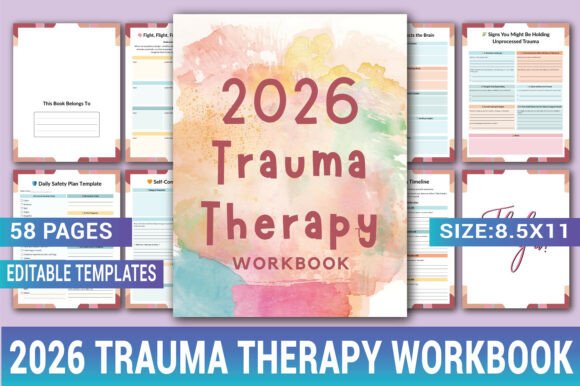
2026 Trauma Therapy Workbook
If you’re someone who carries stress, unresolved experiences, or the quiet weight of past trauma—whether from childhood, relationships, work, health crises, or systemic pressures—you know healing isn’t linear. It’s not about “fixing” yourself. It’s about returning home to your body, reclaiming choice in your responses, and building sustainable emotional safety—day by day. That’s where the 2026 Trauma Therapy Workbook steps in: not as a clinical manual or a quick-fix tool, but as a grounded, year-long companion designed for real life.
A Compassionate Framework for Real-World Healing
This isn’t another generic journal with vague prompts. The 2026 Trauma Therapy Workbook: A Gentle Guide for Healing, Self-Reflection & Emotional Safety is built on trauma-informed principles—meaning every page respects nervous system limits, honors pacing, and avoids retraumatization. It meets people where they are: whether you're newly beginning recovery, deepening work started in therapy, or maintaining stability after significant progress.
What sets it apart is its integration of structure and softness. Monthly calendar spreads don’t just hold appointments—they include gentle reminders for grounding pauses, self-check-ins, and micro-moments of care. Weekly layouts balance practicality (scheduling, habit tracking) with intentional space for reflection—not as homework, but as invitation.
More Than Prompts: Tools That Work With Your Biology
Trauma lives in the body—not just the mind. So the 2026 Trauma Therapy Workbook includes embodied practices you can use *in the moment*: sensory grounding grids, breath-awareness trackers, body scan guides, and tactile-based affirmations. These aren’t abstract concepts. They’re tested, accessible, and designed for use during meetings, commutes, parenting breaks, or late-night overwhelm.
The mood tracking isn’t just “how do I feel today?” It’s layered: noting intensity, duration, physical sensations, possible triggers, and what helped—even if it was just stepping outside for 90 seconds. Over time, patterns emerge—not as data points to judge yourself by, but as quiet insights that build self-trust.
Where This Workbook Fits in Your Daily Ecosystem
Professionals managing high-stakes roles often suppress stress until it leaks out as irritability, fatigue, or decision fatigue. Using the 2026 Trauma Therapy Workbook during Sunday planning or a midweek reset helps name what’s accumulating—and create small, non-negotiable boundaries before burnout takes hold. One educator we spoke with uses the “Boundaries & Relationships” section to draft respectful email templates for overcommitment; another entrepreneur maps energy rhythms alongside deadlines to avoid pushing past capacity.
Creatives and freelancers benefit from its dual focus on emotional regulation *and* creative sustainability. Journaling prompts around creative blocks often uncover unprocessed fear or perfectionism rooted in earlier experiences. The workbook doesn’t ask you to “push through”—it offers alternatives: a 3-minute somatic reset before writing, a values-aligned “no” script, or a “what feels true right now?” check-in before launching a project.
In digital and marketing spaces, emotional labor is constant. The grounding tools and safety-plan templates help users pause before reacting to comments, client feedback, or algorithm shifts—building response flexibility instead of reflexive defensiveness. And because the layout is clean, printable, and discreet, it works equally well on a tablet during a coffee shop break or as a printed spread beside your laptop.
Designed for Integration, Not Isolation
You don’t need to be in therapy to use the 2026 Trauma Therapy Workbook—but if you are, it enhances continuity between sessions. Therapists report clients arrive more prepared, recall insights more clearly, and identify subtle shifts they might otherwise miss. Some clinicians recommend specific pages based on treatment phase: nervous system education early on, boundary mapping mid-process, integration reflections later.
For educators and trainers, the trauma education sections serve as accessible primers—not for diagnosis, but for understanding how stress impacts learning, retention, and group dynamics. The language avoids jargon; concepts like window of tolerance or dorsal vagal shutdown are explained with analogies and body-based examples—not definitions alone.
Practical Considerations Before You Begin
This workbook works best when used flexibly—not rigidly. Skipping a week? No problem. Repeating a grounding exercise three days in a row? That’s resilience in action. Its value isn’t in completion—it’s in consistency of return.
Consider how you engage with paper vs. digital tools. While printable PDF versions exist, the physical act of writing by hand activates different neural pathways—especially helpful for memory consolidation and emotional processing. If you prefer digital, look for versions optimized for note-taking apps with stylus support (like GoodNotes or Notability), but be mindful of screen fatigue during emotionally sensitive work.
Also notice your environment. The 2026 Trauma Therapy Workbook includes safety-planning pages for identifying supportive people, calming spaces, and exit strategies—not just for crisis, but for everyday overwhelm. Use those pages *before* you need them. One freelance designer keeps hers open on her desk during contract negotiations; another pins her “calm-down kit” list to the fridge.
Why This Timing Matters
2026 isn’t arbitrary. It’s a deliberate choice—a full year ahead, offering psychological breathing room. You’re not trying to heal *this month*. You’re building capacity *across seasons*. Winter pages hold space for rest and internal reflection; spring invites gentle experimentation; summer supports expansion and connection; autumn invites integration and release. The workbook mirrors natural cycles—not productivity culture’s relentless pace.
It also reflects evolving understandings of trauma: less focused on singular “big T” events, more attuned to complex, relational, and cumulative stressors—especially relevant for marginalized professionals, caregivers, remote workers, and anyone navigating chronic uncertainty.
A Resource That Grows With You
What makes the 2026 Trauma Therapy Workbook stand out long-term is its refusal to pathologize. There’s no “progress chart” demanding upward movement. Instead, there are pages titled “What Did I Protect Today?” or “When Did I Feel Safe Enough to Pause?”—reframing healing as presence, not performance.
Its design balances warmth and clarity: soft blues and muted earth tones reduce visual overwhelm; ample white space prevents cognitive load; typography prioritizes readability over decoration. Even the paper stock (in printed editions) is chosen for smooth writing and durability—because healing shouldn’t be hindered by a bleed-through page or a torn corner.
Whether you’re rebuilding after loss, navigating identity shifts, recovering from workplace harm, or simply seeking deeper self-knowledge—the 2026 Trauma Therapy Workbook offers something rare: structure without rigidity, guidance without pressure, and compassion that doesn’t ask you to earn it.