2026 Witchcraft Tarot Workbook Canva
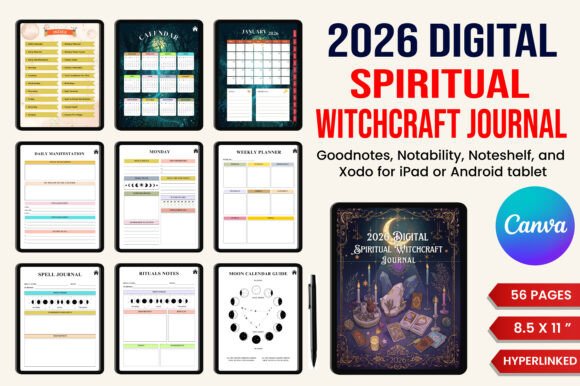
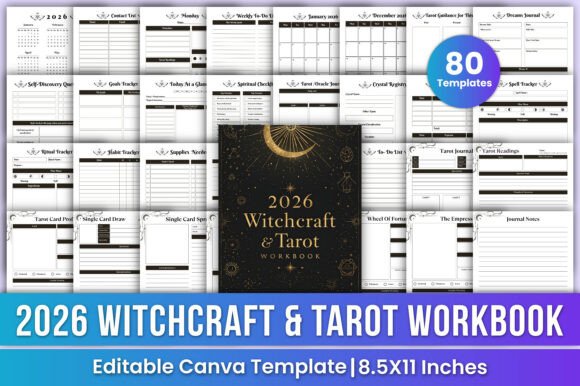
The 2026 Witchcraft Tarot Workbook Canva is a digital, editable planner and journal designed for practitioners integrating tarot, lunar cycles, manifestation work, spellcraft, and daily spiritual practice. It is delivered as a customizable Canva template—meaning users receive a shareable link to edit text, colors, fonts, and layout—and includes high-resolution, print-ready 8.5×11 inch PDF files for offline use.
This workbook is not a physical book or a pre-filled journal. Instead, it functions as a flexible framework: a structured yet adaptable system for organizing magical practice across the year 2026. Its content spans calendar-based planning (including holidays and moon phases), daily ritual tracking, tarot journaling, intention setting, and self-care integration.
Who Might Find This Workbook Useful?
Individuals who maintain an active, reflective spiritual practice—and who value consistency without rigidity—may find the 2026 Witchcraft Tarot Workbook Canva especially relevant. This includes:
- Witches, tarot readers, or energy workers seeking a unified space to log readings, spells, and manifestations;
- Beginners building routine around lunar timing, card pulls, and intentional action;
- Those who prefer digital customization over static printed journals;
- Practitioners who already use Canva and want to retain control over visual design and personal symbolism.
It’s also suitable for people who regularly print their planners but want flexibility in formatting before doing so—such as adjusting spacing for handwriting, swapping icons, or aligning color palettes with personal correspondences (e.g., green for abundance, purple for intuition).
Key Benefits of Using This Template
The primary advantage lies in its modularity. Because it’s built for Canva, users can:
- Change font pairings to match aesthetic preferences (e.g., serif for tradition, sans-serif for modern minimalism);
- Adjust color schemes to reflect seasonal energies or elemental associations;
- Reorder or duplicate pages—for example, adding extra tarot reflection sheets during Mercury retrograde periods;
- Insert personal symbols, sigils, or deck-specific notes directly into designated sections.
The inclusion of both digital editing capability and print-ready PDFs supports hybrid workflows. Someone might draft intentions digitally, then print weekly spreads for altar work or handwritten reflection.
Structurally, the workbook balances breadth and focus: it offers dedicated spaces for tarot (single-card pulls, three-card spreads, Major Arcana profiles), moon phase tracking, spell documentation, and manifestation scaffolding—including prompts, visualization cues, and actionable steps. This reduces the need to juggle multiple notebooks or apps.
Tradeoffs and Practical Considerations
While flexibility is a strength, it requires time and familiarity. Users unfamiliar with Canva may face a learning curve—not in complexity, but in navigating layers, resizing elements, or exporting correctly. Those expecting plug-and-play functionality (like a fillable PDF with automatic date generation) may find the manual setup less convenient.
Additionally, because the template is not app-based, it lacks features like reminders, syncing across devices, or searchable entries. If digital searchability or cloud backup is essential, a note-taking app (e.g., Obsidian or Notion) with custom templates may offer more long-term utility—even if requiring more initial setup.
Another consideration: the workbook follows a fixed 2026 calendar. While holidays and moon phases are pre-populated, users must verify accuracy against authoritative astronomical sources if precision is critical for ritual timing. Minor discrepancies may occur depending on time zone or calculation method used in the template’s data sourcing.
When This Workbook Is a Strong Fit
The 2026 Witchcraft Tarot Workbook Canva works well when:
- You prioritize tactile journaling but want to personalize layout and aesthetics before printing;
- Your practice benefits from consistent structure—especially around daily tarot, lunar tracking, and weekly goal-setting;
- You’re comfortable managing digital files and prefer owning editable assets rather than subscribing to services;
- You value having one document that merges planning, reflection, and magical record-keeping without switching between tools.
It also suits those who teach or mentor others in witchcraft or tarot and wish to adapt the same framework for students—customizing prompts or emphasis based on group needs.
When Alternatives May Be Worth Exploring
If your goals emphasize automation, mobility, or deep database functionality, consider alternatives such as:
- Notion templates: Offer relational databases (e.g., linking a spell entry to its corresponding moon phase or tarot card), recurring templates, and mobile sync—but require more configuration and lack out-of-the-box visual polish;
- Dedicated tarot journaling apps (e.g., Tarot Journal, Labyrinthos): Focus specifically on card logging, spread analysis, and deck management, often with AI-assisted interpretation—but rarely include moon phase or spell tracking;
- Print-on-demand physical journals: Provide high-quality paper and binding but no editing capability after purchase; changes require repurchasing or manual annotation.
Similarly, if you primarily engage with spiritual practice through voice notes, audio reflection, or video journaling, a static workbook—no matter how well-designed—won’t accommodate those modalities without additional tool integration.
Making a Practical Decision
To determine whether the 2026 Witchcraft Tarot Workbook Canva aligns with your needs, ask yourself:
- Do I currently use or feel comfortable using Canva for personal projects?
- Do I benefit from having a single, cohesive system for tarot, spells, and manifestation—or do I prefer separating these activities across different tools?
- Is my 2026 practice likely to follow a consistent rhythm (e.g., daily pulls, weekly rituals) that would be supported by structured templates?
- Do I value visual customization enough to invest time in editing, or would I prefer something ready-to-use with minimal setup?
If most answers trend toward “yes,” this workbook offers a grounded, adaptable foundation. If your workflow leans heavily toward dynamic interaction, cross-device access, or non-text-based reflection, evaluating complementary or alternative tools may better serve your long-term practice.
Ultimately, the 2026 Witchcraft Tarot Workbook Canva is a tool—not a prescription. Its usefulness depends less on its features in isolation and more on how closely those features map to your existing habits, technical comfort, and spiritual priorities for the year ahead.