2026 Digital Spiritual Witchcraft Journal
The 2026 Digital Spiritual Witchcraft Journal is a downloadable, editable digital planner designed for individuals who integrate spiritual practice into daily life. It is not software or an app, but a structured collection of printable and customizable pages—delivered as PDF files and editable Canva templates—intended for use on devices or printed for handwritten reflection. Its framework centers around lunar cycles, tarot interpretation, intention-setting, ritual documentation, and personal tracking, all organized within a 2026 calendar year.
People often seek tools like the 2026 Digital Spiritual Witchcraft Journal when they want consistency in spiritual practice without relying on fragmented apps or unstructured notebooks. It appeals to those who value intentionality but may feel overwhelmed by designing their own system from scratch. The journal assumes familiarity with foundational concepts—such as moon phases, zodiac signs, basic tarot symbolism, and common correspondences (e.g., crystals, herbs)—but does not require advanced expertise. It functions best as a scaffold, not a teacher.
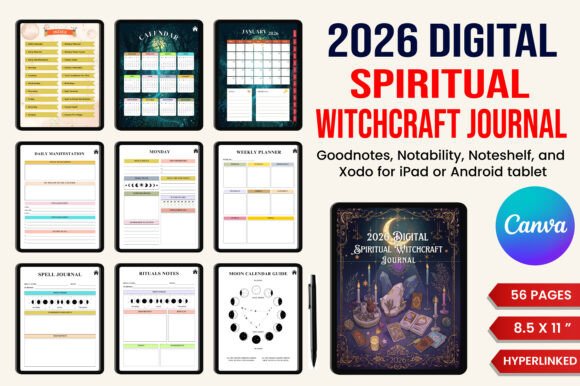
One benefit is its integrative design: daily manifestation prompts sit alongside weekly moon cycle summaries; spellwork worksheets include dedicated fields for supplies and ritual notes; and habit and mood trackers support embodied awareness alongside esoteric practice. The inclusion of both practical tools (password tracker, contact list, brain dump pages) and symbolic ones (Wheel of Zodiac, Moon Spell-work with Zodiacs) reflects an understanding that spiritual work coexists with everyday responsibilities. The 56 Canva templates allow for visual customization—useful for users who respond to color, layout, or iconography in their practice.
However, there are tradeoffs. Because it is digital-first, consistent use requires either reliable access to a tablet with stylus support or regular printing—neither of which suits every lifestyle. Users who prefer analog-only systems may find the need to switch between screen and paper disruptive. Similarly, while the Canva link enables editing, it presumes comfort navigating Canva’s interface; those unfamiliar with the platform may face a learning curve before personalizing layouts or fonts. The journal also does not include instructional content—there are no explanations of how to interpret moon-in-Leo versus moon-in-Cancer, nor guidance on building a crystal grid. It assumes users already hold or will source that knowledge elsewhere.
Another consideration is scope. The journal includes many features—tarot guidance per month, birthday tracking, affirmation lists, gratitude prompts—but depth varies. For example, “Tarot Guidance For This Month” appears as a recurring section, yet the journal does not specify whether interpretations are pre-written, blank for user input, or tied to a particular deck. Similarly, “Crystal For Magic” and “Herbs For Medicine” are labeled categories, but no reference charts or safety notes accompany them. Users should expect to fill in meaning, not receive curated recommendations.
The 2026 Digital Spiritual Witchcraft Journal is a strong fit for practitioners who:
- Already maintain a regular spiritual routine and want a unified place to record moon observations, spell outcomes, and intuitive insights;
- Prefer modular, self-directed planning over guided programs or subscription-based platforms;
- Value aesthetic coherence and wish to adjust colors, fonts, or layout to reflect personal symbolism;
- Work across formats—sometimes typing, sometimes writing by hand—and appreciate having both PDF and editable versions;
- Seek structure without rigidity, where sections like “Brain Dump” or “Ritual Notes” invite flexibility rather than prescriptive steps.
It may be less suitable for beginners seeking foundational education. Someone new to moon phase tracking, for instance, might benefit more from a resource that explains waxing versus waning energy *before* asking them to plan spells accordingly. Likewise, users who rely heavily on audio, video, or community features—like guided meditations, group rituals, or real-time astrological alerts—will find this journal silent and solitary by design. It offers space, not instruction; reflection, not direction.
Alternatives worth considering depend on individual priorities. Those focused primarily on lunar timing might explore dedicated moon-phase calendars with integrated journaling prompts—not tied to a fixed year. Practitioners invested in tarot may prefer a separate tarot logbook with space for card draws, reflections, and spread analysis. For users prioritizing habit formation or mental wellness, secular planners with robust mood and habit tracking (e.g., full-page weekly spreads with emotional check-ins) may offer more nuanced behavioral insight than the spiritual journal’s condensed versions. And for those wanting live updates—such as exact moon phase times adjusted for time zone—the 2026 Digital Spiritual Witchcraft Journal’s static PDF format means manual cross-referencing with external astronomical sources.
Practical decision-making starts with clarifying intent. Ask: What do I currently track—or wish I tracked—in my practice? If the answer includes recurring themes like “I forget to align spells with moon phases” or “I lose track of which crystals I used and how I felt afterward,” then the journal’s dedicated worksheets (Moon Spell-work with Zodiacs, Crystal Spell, Ritual Notes) address concrete gaps. But if the challenge is uncertainty about *what* to track—or how different elements relate—then pairing this journal with a beginner-friendly guide or course may be more effective than using it in isolation.
Also consider workflow compatibility. Does your current note-taking happen in Notion, Obsidian, or GoodNotes? While the journal’s PDFs can be imported, the Canva templates are not natively compatible with those platforms. You’ll need to export edited pages as PDFs to use them elsewhere. Conversely, if you already use Canva for other creative projects, the included templates integrate smoothly into that existing flow.
Finally, assess longevity. Because it is dated for 2026, the journal is not reusable across years. That makes it appropriate for someone committed to working intentionally within that specific cycle—but less ideal for those who prefer evergreen tools or rotate practices annually. The “Yearly Goals” and “GOALS TRACKER” sections reinforce this time-bound orientation, encouraging reflection anchored to a single calendar year rather than ongoing cycles.
In summary, the 2026 Digital Spiritual Witchcraft Journal serves as a well-organized container—not a curriculum. Its usefulness depends less on what it contains and more on how well its structure matches your existing habits, learning preferences, and technical environment. It supports consistency, integration, and personalization for those who know what they’re practicing and simply need a thoughtful place to record it.