30 Days Lettering Worksheet Practice
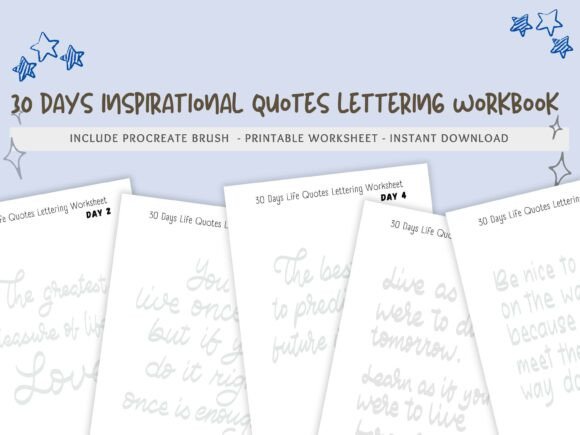
Imagine starting each day with five minutes of focused, joyful mark-making—no pressure, no perfectionism, just a single inspirational quote, thoughtfully laid out for you to trace, rework, or reinterpret. That’s the quiet power of the 30 Days Lettering Worksheet Practice: a curated, 30-page workbook built around life-affirming quotes, designed not just to build muscle memory, but to gently shift your mindset as you practice.
What It Is—and What It’s Not
This isn’t a rigid calligraphy syllabus or a technical manual on pen angles and x-heights. It’s a daily companion—30 pages, one for each day—that invites you to engage with letterforms in a way that feels personal and sustainable. Each worksheet features an original layout using a custom Procreate brush called “Dreamy,” which creates expressive thin-and-thick strokes *without* pressure sensitivity. That means the contrast comes from shape and direction—not how hard you press. The result? A softer, more fluid, almost watercolor-like rhythm in the letters.
You’ll receive two PDF sizes (A4 and A5), plus a ready-to-open Procreate file pre-loaded with the Dreamy brush. Print it, sketch on it, or open it on your iPad and draw directly over the guides. No extra setup. No guesswork.
Why It Resonates—Differently—for Different People
A graphic designer might use this to warm up before client work—reconnecting with rhythm and balance without committing to a full sketch. A teacher could project a page during morning circle, inviting students to copy a line like *“You are enough, exactly as you are”* while discussing self-worth and expression. A small business owner launching a wellness brand might adapt layouts into social media graphics, noticing how the Dreamy brush’s gentle contrast lends warmth to digital posts.
For someone managing anxiety or ADHD, the predictability of “one page, one day” lowers the barrier to creative practice. There’s no need to plan, source fonts, or edit layers—just show up and move your hand. For retirees rediscovering creativity after decades, the absence of technical jargon or strict rules makes it feel accessible, not intimidating.
Beginners: Clarity Over Complexity
If you’ve tried lettering before and felt lost in terminology—ascenders, baseline, slant angle—you’ll appreciate that this workbook sidesteps theory in favor of tactile familiarity. You’re not learning *about* contrast—you’re *feeling* it through repetition. Because the Dreamy brush builds stroke variation into the shape itself, even tracing with a pencil reveals how curves widen and narrow. That kind of embodied understanding often sticks longer than memorized rules.
Tip for beginners: Start with the A5 printout and a fine-tip marker. No brush pens needed yet. Focus on matching the flow—not the thickness.
Experienced Letterers & Digital Creators
You likely already own dozens of brushes and have strong muscle memory. Here, the value shifts: it’s about *intentional constraint*. Working within the Dreamy brush’s unique behavior—no pressure input, no layer blending, just deliberate placement—can spark fresh compositional ideas. Try flipping the page upside-down and redrawing the quote in reverse. Or duplicate the Procreate file and experiment with color overlays or texture stamps behind the letters.
The non-pressure-sensitive nature also makes it ideal for animating simple lettering sequences in Procreate—since stroke weight stays consistent across frames.
Educators & Coaches
This is classroom-ready in under 30 seconds. Print a week’s worth and place them in a “mindful writing” station. Pair a quote like *“Mistakes are proof you’re trying”* with a reflective journal prompt. Use the A4 version on a document camera to model slow, intentional letter formation—emphasizing breath, spacing, and pause—not speed or flair.
Because the layouts avoid tight kerning or complex flourishes, they’re legible at a distance and adaptable for learners with visual processing differences.
Hobbyists & Mindful Practitioners
You don’t need a goal beyond showing up. Some users treat it like meditation with ink—focusing only on the movement of the tip, the sound of the pen, the slight resistance of paper. Others keep a “progress stack,” saving each day’s page to flip through at month’s end. You’ll notice subtle shifts: letters sit more confidently on the baseline, spacing feels more intuitive, your hand stops second-guessing every curve.
And because the quotes center themes like resilience, presence, and self-compassion, the practice doubles as emotional scaffolding—especially during transitions, recovery, or periods of uncertainty.
Practical Notes—So You Know What to Expect
- Printing works—but differently. If you use brush pens, the Dreamy stroke may feel unfamiliar at first. That’s normal. Try using a chisel-tip highlighter instead—it mimics the brush’s broad-narrow rhythm without requiring pressure control.
- No iPad? No problem. All layouts are clear in black-and-white PDFs. Pencil, gel pen, fountain pen—even a stick of charcoal—will let you explore the shapes.
- It’s not about replication. Trace once. Then try redrawing freehand beside it. Then simplify it into all caps. Then turn it into a border. Flexibility is built in—not added on.
- Commercial use is limited. You can adapt pages for personal branding or client projects, but the Dreamy brush and original quote layouts aren’t licensed for resale as standalone templates.
Does This Fit Your Rhythm?
Ask yourself: Do you want structure *with* space? Growth *without* grading? Beauty *alongside* grounding? If yes—this workbook meets you where you are. It won’t replace deep-dive calligraphy study, nor does it aim to. But it *does* offer consistency, kindness, and craft in equal measure.
Whether you’re building a portfolio, supporting students, launching a side hustle, or simply remembering how good it feels to make something by hand—30 Days Lettering Worksheet Practice gives you permission to begin again, gently, each day.