50 Worksheets Activities for Kids
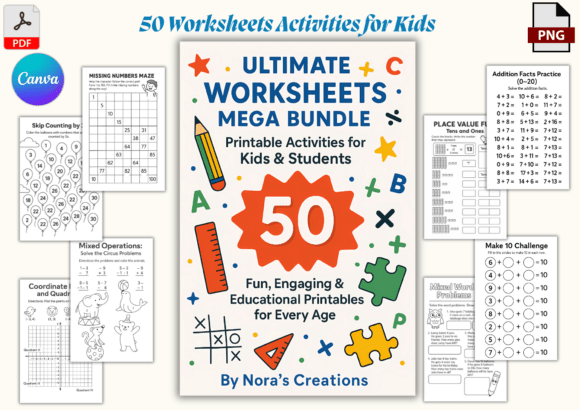
For educators, homeschooling parents, and curriculum designers who prioritize practicality without sacrificing engagement, the 50 Worksheets Activities for Kids—marketed as the Ultimate 50 Worksheets Mega Bundle—represents a tightly scoped, execution-focused resource. At 53 pages and formatted to a standard 6×9 inch layout, it avoids the sprawl common in oversized educational bundles while delivering consistent, classroom-ready material across core early-learning domains: numeracy, literacy, logical reasoning, fine motor development, and creative expression.
A Purpose-Built Format, Not Just Volume
The decision to standardize on 6×9 inches is more intentional than it first appears. That size fits comfortably on US letter (8.5×11) and A4 paper with clean margins—no trimming or scaling required—and prints legibly even on mid-tier home inkjets. Unlike many digital worksheet collections that assume high-resolution laser printers or laminators, this bundle assumes realistic constraints: shared school printers, budget-conscious homeschoolers, and on-the-fly lesson adjustments. Each page is designed as a standalone activity—not part of a progressive sequence—so users can extract value without needing to follow a prescribed order or prerequisite skill level.
What’s Inside—and What’s Not
The collection includes:
- Math practice: Number tracing, simple addition/subtraction grids, shape identification, and pattern completion—structured to reinforce procedural fluency without relying on abstract language.
- Reading & writing support: Letter-sound matching, CVC word building, sentence tracing, and guided drawing prompts tied to vocabulary (e.g., “draw what ‘sun’ looks like”).
- Puzzles & problem-solving: Mazes, spot-the-difference visuals, basic logic grids, and sequencing strips—all using intuitive visual cues rather than dense instructions.
- Creative exercises: Open-ended drawing prompts, coloring-with-purpose tasks (e.g., “color only the things that fly”), and cut-and-paste storytelling elements.
Notably absent are flashcards, lesson plans, answer keys, or assessment rubrics. This isn’t a turnkey curriculum—it’s a toolkit. Its strength lies in modularity: a second-grade teacher might pull three math pages for morning warm-ups, while a speech-language pathologist selects five picture-based prompts for articulation practice. There’s no narrative arc or pedagogical theory baked into the design; instead, clarity, repetition, and visual hierarchy drive usability.
Quality and Consistency Across Formats
The dual PDF and PNG delivery adds tangible flexibility. PDFs preserve vector text and crisp lines—ideal for repeated printing or annotation in apps like GoodNotes or Kami. PNGs allow direct embedding into digital learning platforms (Google Slides, Seesaw), custom slide decks, or printed handouts where background transparency matters. All files use a limited, high-contrast color palette (navy, forest green, burnt orange, black) and sans-serif typefaces—tested for readability by children with emerging visual processing skills. No decorative borders compete with content; whitespace is generous but purposeful, reducing cognitive load during independent work.
That said, consistency doesn’t mean uniformity. Within the 50 worksheets, difficulty ramps subtly—not linearly. For example, number tracing begins with 1–5, then shifts to skip-counting by 2s up to 20, then introduces simple equations like “__ + 3 = 7.” The progression respects developmental variability without forcing rigid grade-level alignment. It works best when treated as a spectrum of options—not a syllabus.
Real-World Use Cases and Limitations
In practice, the 50 Worksheets Activities for Kids shines in three contexts:
- Substitute or emergency lesson support: When a teacher needs 20 minutes of quiet, structured work—without prep—this bundle delivers immediately printable, non-device-dependent tasks.
- Homeschooling reinforcement: As a low-stakes supplement to core instruction, especially for skill maintenance during breaks or for learners who benefit from tactile repetition.
- Therapeutic or small-group scaffolding: Occupational therapists use the tracing and cutting pages for fine motor goals; ESL tutors adapt the image-labeling sheets for vocabulary building with minimal language demand.
Its limitations are equally practical. It doesn’t replace differentiated instruction—there are no editable text fields, no audio components, and no built-in scaffolds for neurodiverse learners beyond visual clarity. It won’t suit educators seeking project-based, inquiry-driven, or tech-integrated resources. And because it’s activity-focused—not concept-driven—it’s less effective for deep conceptual exploration (e.g., “why does subtraction work?”). It supports practice, not discovery.
Who Benefits Most—and How to Use It Well
This resource aligns best with practitioners who already understand their students’ needs and want efficient, aesthetically coherent materials to fill specific gaps. A kindergarten teacher noticing inconsistent pencil control might assign two tracing sheets daily for a week—not as busywork, but as targeted muscle training. A freelance curriculum designer building a summer camp packet could extract 12 puzzle and creativity pages, rebrand them with custom headers, and integrate them into a themed activity guide. A blogger creating a “Back-to-School Printables Roundup” would find the clean layout and PNG compatibility ideal for embedding in tutorials or downloadable lead magnets.
To maximize utility, avoid treating the entire bundle as one unit. Instead:
- Tag and sort digitally: Rename files descriptively (“math_addition_01”, “reading_cvc_03”) before saving—especially helpful when pulling assets for multiple age groups.
- Print selectively: Use the PDF’s thumbnail view to preview before printing; many pages work equally well in grayscale, reducing ink costs.
- Extend manually: Add verbal prompts (“Tell me about your drawing”), peer discussion questions, or real-world connections (“Find something in this room that’s shaped like the hexagon you just traced”).
Long-Term Value and Practical Fit
At 53 pages, the bundle avoids bloat while offering enough variety to remain useful across multiple school years—particularly for multi-age homeschool settings or resource rooms serving K–3. Because it’s not tied to a specific standards framework (e.g., Common Core or TEKS), it sidesteps obsolescence when standards shift. Its longevity comes from focusing on foundational, transferable skills rather than trend-dependent themes.
That said, its value scales with user intentionality. It won’t automate teaching—but it reliably reduces friction in delivering consistent, low-prep practice. For time-constrained professionals who’ve spent too long searching for “just one more counting worksheet that doesn’t look like clip art,” the 50 Worksheets Activities for Kids delivers exactly what its title promises: 50 functional, printable activities—no more, no less.