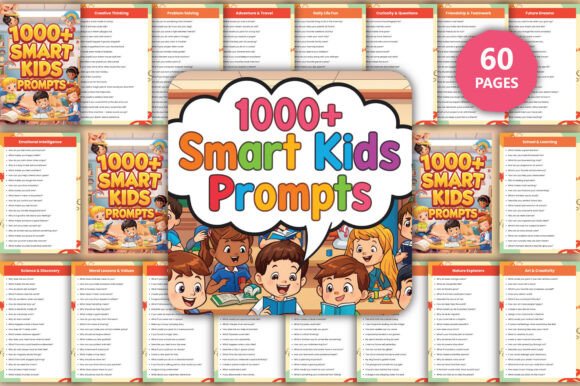
1000 Drawing Story Prompts for Kids
For educators designing weekly literacy stations, homeschoolers building flexible learning rhythms, or creators developing printable resources for young audiences, 1000 Drawing Story Prompts for Kids functions as a precision tool—not just inspiration, but a repeatable, scalable component in creative workflow design. It’s not a standalone “activity book” in the traditional sense. Instead, it’s a modular prompt engine: 1000 discrete, thematically grouped ideas engineered to activate drawing, narrative construction, and emotional articulation—simultaneously—in children aged 5–12.
Where many classroom or home resources demand heavy facilitation—lesson plans, prep time, differentiation layers—this collection reduces cognitive load on adults by design. Each prompt is self-contained, visually anchored, and open-ended enough to accommodate varying skill levels, language development stages, and attention spans. That makes it especially valuable when integrated into existing structures: morning warm-ups, transition buffers between subjects, SEL-aligned reflection time, or low-pressure assessment alternatives.
How It Fits Into Real Workflows
In practice, 1000 Drawing Story Prompts for Kids works best when treated as infrastructure—not decoration. Think of it like a well-organized asset library: you don’t wait for inspiration to strike before opening it. You schedule access, align it with objectives, and treat output as data.
- Before a lesson or session: Scan the Dreamy Nights or Nature Wonders categories to match upcoming science or literature themes. A prompt like “Draw the tree that remembers every season—and write what it whispers at dusk” scaffolds observational thinking while inviting metaphorical language, making it ideal for pre-reading discussion or sensory grounding before writing.
- During group work: Assign prompts by category to small teams—e.g., one group explores Time Travel Tales, another tackles Funny Moments. The built-in variety ensures parallel tasks stay distinct yet equally accessible. Because each page includes space for both drawing and writing (even if just a sentence), output naturally supports multimodal documentation—useful for portfolios, progress tracking, or parent communication.
- After completion: Use completed pages not just as artifacts, but as diagnostic touchpoints. Do recurring motifs emerge? Are certain categories consistently avoided or overused? That signals where scaffolding may be needed—or where interest can be deepened through extension (e.g., turning a single “Underwater Fun” sketch into a collaborative class mural or stop-motion storyboard).
Integration With Other Tools and Platforms
The editable Canva link included with the resource is where practical interoperability begins. Unlike static PDFs that lock users into fixed layouts, this version allows direct customization: resizing text for emerging readers, swapping icons for culturally responsive visuals, adding bilingual labels, or embedding QR codes linking to audio storytelling models. For educators using LMS platforms like Google Classroom or Canvas, individual prompts can be exported as PNGs and embedded into assignment instructions—no reformatting required.
It also complements widely adopted frameworks without friction. In Reggio Emilia–influenced settings, prompts serve as “provocations”—invitations to investigate, question, and represent understanding. In Orton-Gillingham or structured literacy contexts, they provide low-stakes opportunities to practice phonemic awareness (“Draw three things that start with /sh/ and tell their story”) or syntax building (“Show what happens when the robot sneezes—and write one sentence about it”). For art therapists or counselors, the Friendship and Feelings & Faces categories offer nonverbal entry points to discuss social dynamics or internal states—especially useful when verbal expression is still developing.
Preparation and Setup Efficiency
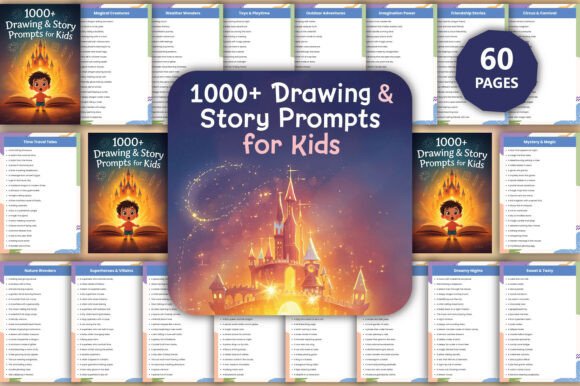
Setup takes under two minutes: open the Canva file, duplicate a page, adjust font size if needed, and print—or assign digitally. No laminating, cutting, or sorting. Because prompts are organized into 50 clear categories (not just random numbers), filtering is intuitive. Need something calming before lunch? Go to Quiet Places. Prepping for a unit on ecosystems? Pull from Jungle Journeys or Ocean Layers. This level of organization eliminates decision fatigue during high-demand moments—like managing 20 kids after recess or juggling virtual and in-person learners simultaneously.
Long-Term Use and Consistency
Sustained use depends less on novelty and more on predictable structure. Children thrive when they know what to expect: a prompt appears, they choose how deeply to engage (sketch only, add speech bubbles, write a full paragraph), and the result belongs to them—not to a grade or checklist. That autonomy builds consistency. Educators report stronger participation when prompts rotate weekly rather than daily; it gives time for ideas to percolate and for children to revisit favorite themes with new skills.
Quality control is built in through thematic balance. No category dominates. Magical Creatures appears alongside Real-Life Helpers. Space Adventures sit beside Backyard Explorers. This prevents over-indexing on fantasy at the expense of observation or lived experience—keeping output grounded and relatable. And because the layout uses cheerful typography and ample white space (not cluttered clipart), pages remain legible even after repeated handling or digital zooming.
Workflow Example: Homeschool Weekly Planning
A parent planning a four-day literacy block might allocate prompts like this:
- Monday (Observation + Description): Choose a prompt from Nature Wonders. Child sketches a real or imagined plant, then writes three sensory details (“It feels bumpy,” “It smells like rain,” “It sounds like rustling paper”). Used to build descriptive vocabulary and close-looking habits.
- Tuesday (Narrative Structure): Select from Problem-Solving Pals. Child draws a character facing a challenge (e.g., “The mailbox won’t open”) and shows one solution—and its consequence. Reinforces cause/effect and sequencing without requiring full paragraphs.
- Wednesday (Emotional Literacy): Pull from Feelings & Faces. Child draws a face showing surprise, then writes or dictates what made it happen—and what came next. Supports emotional identification and regulation practice.
- Thursday (Creative Synthesis): Let child pick any prompt. They may combine categories—e.g., “A superhero who lives underwater and helps lost seahorses.” Encourages ownership and cross-thematic thinking.
This rhythm doesn’t require new materials each week. Just consistent access, light facilitation, and attention to how the child engages—not just what they produce.
Who Benefits Beyond the Child?
Freelance illustrators developing children’s book concepts use the prompts to generate quick visual thumbnails tied to narrative hooks—testing character appeal, setting clarity, and emotional resonance in under five minutes. Curriculum designers embed selected prompts into scope-and-sequence documents as “creative response options” alongside reading assignments. Small publishers repurpose categorized prompts into themed activity packs—100 Space Adventure Prompts, 50 Friendship Sketch Challenges—with minimal adaptation thanks to the clean Canva source file.
Even productivity-focused parents or entrepreneurs find utility—not as entertainment, but as a calibrated pause. Ten minutes with a prompt resets attention, activates divergent thinking, and models creative risk-taking. When adults join in (drawing their own version of “The Door That Only Opens When You Sing”), they demonstrate process over product—a subtle but powerful lesson in growth mindset.
In short, 1000 Drawing Story Prompts for Kids earns its place not by being exhaustive, but by being executable. It meets real constraints—time, bandwidth, developmental range—and delivers consistent, observable outcomes: increased willingness to draft, richer oral language during sharing, more sustained focus during independent work, and clearer evidence of conceptual understanding through visual-narrative synthesis. That’s not magic. It’s thoughtful design, aligned to how creativity actually takes root—and grows.