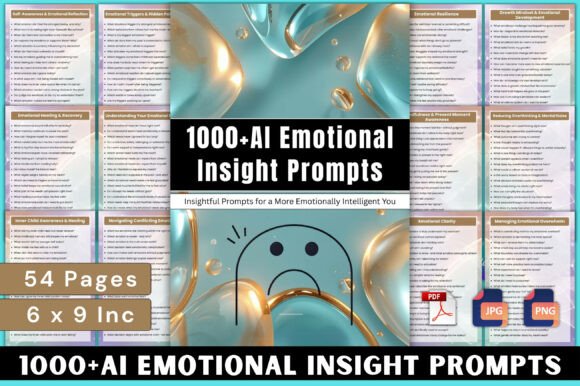
1000 AI Emotional Insight Prompts
What if your next breakthrough didn’t come from a strategy session or a productivity hack—but from a single, well-placed question?
1000 AI Emotional Insight Prompts is not another journaling gimmick. It’s a rigorously organized, deeply human collection of over 1,000 reflective prompts—each designed to bypass surface-level thinking and land where real emotional work happens: in the quiet space between what you feel and what you understand.
Created for people who value clarity over cliché, this resource meets you where you are—whether you’re a designer mapping client empathy, an educator building emotional literacy in students, a therapist seeking fresh entry points with clients, or a founder navigating burnout and decision fatigue. Its strength lies in structure *and* flexibility: prompts are grouped into intuitive emotional categories (like Emotional Regulation, Inner Child Exploration, or Fear & Anxiety), yet each one stands alone—ready to be adapted, remixed, or embedded into your existing workflow.
Creative Applications Beyond Journaling
While journaling remains a powerful anchor, these prompts thrive in unexpected contexts:
- AI-Assisted Reflection: Feed a prompt into a trusted AI tool—not to get answers, but to generate follow-up questions, reframe assumptions, or identify emotional contradictions in your own responses. Try: “What does my resistance to this feeling reveal about a need I’ve stopped naming?” Then ask AI to suggest three gentle, non-judgmental reframes.
- Team Check-Ins: Replace generic “How are you?” with intentional emotional scaffolding. A marketing team launching a high-stakes campaign might use prompts from the Resilience Building or Mental Noise sections to surface unspoken stress before it derails collaboration.
- Content Creation: Bloggers and educators can transform prompts into micro-lessons: a 90-second Instagram carousel on “3 Questions to Ask When You Feel Overwhelmed,” pulling directly from the Anxiety Management category. No fluff—just actionable insight grounded in emotional intelligence.
- Workshop Design: Freelancers and coaches can build 60- or 90-minute sessions around a single theme—e.g., Emotional Boundaries—using 3–5 curated prompts as discussion anchors, paired with short writing sprints and small-group reflection.
Practical Adaptation by Role
One size doesn’t fit all—and 1000 AI Emotional Insight Prompts doesn’t ask it to.
For creators and designers: Use prompts from Identity and Alignment sections to audit creative blocks. Ask: “When did I last create something purely because it felt true—not because it was ‘on brand’ or ‘marketable’?” Track patterns over time. This isn’t self-help—it’s data collection about your authentic voice.
For educators and trainers: Pull prompts from Compassion or Communication and adapt them for age-appropriate group activities. A middle-school SEL lesson might simplify “What emotion am I mistaking for anger right now?” into a visual emotion wheel exercise. High school or adult learners can engage with the full prompt—paired with anonymized peer sharing.
For small business owners and solopreneurs: Leverage prompts under Letting Go and Breaking Old Patterns during quarterly reviews. Instead of only analyzing revenue, ask: “What belief about success am I carrying from my first year that no longer serves my current capacity?” That question often uncovers operational friction faster than any spreadsheet.
Keeping It Clear, Consistent, and Useful
Using 1,000+ prompts effectively isn’t about doing them all—it’s about choosing intentionally and returning consistently. Here’s how to avoid overwhelm and sustain impact:
- Start with one category per month. Pick a theme tied to your current reality—e.g., Grief after a project ends, or Confidence before a major pitch. Work through 2–3 prompts weekly. Consistency > volume.
- Tag and archive responses. Whether digital or analog, label entries by category and date. Over time, you’ll spot shifts: Where did your language around “self-love” change? When did “fear” begin appearing alongside “curiosity” instead of “avoidance”?
- Pair with action—not just insight. After responding to a prompt like “What boundary do I keep crossing to please others?”, write one concrete step: “I will decline one non-essential request this week—and name my reason aloud.” Insight without movement stays theoretical.
- Respect your rhythm. Some prompts land immediately. Others sit quietly for days—or weeks—before resonating. That’s part of the process. Don’t force meaning. Let the question do its work in the background.
Why This Works Where Other Tools Fall Short
Most emotional tools swing between two extremes: oversimplified affirmations (“You’ve got this!”) or clinical detachment (“Identify the cognitive distortion”). 1000 AI Emotional Insight Prompts lives in the fertile middle ground—thoughtful but accessible, structured but spacious.
It avoids vague abstraction by anchoring every prompt in tangible experience: not “What do you want?” but “What physical sensation shows up when you imagine saying ‘no’ to this request?” It supports healing without demanding confession—offering pathways in, not pressure to perform vulnerability.
And because it’s designed to integrate—not replace—it works alongside therapy, meditation, coaching, or even daily stand-ups. A therapist might assign a prompt from Inner Child Exploration as homework. A meditation app could embed one prompt per day in a “Mindful Awareness” track. A Notion template for freelancers might include a rotating prompt from Confidence or Alignment in their weekly review section.
This isn’t about fixing yourself. It’s about knowing yourself with more precision—so your creativity has direction, your communication has resonance, and your decisions reflect who you actually are—not who you think you should be.
If you’ve ever paused mid-sentence, mid-decision, or mid-scroll—and wondered, “Wait—what am I really feeling right now?”—this collection meets you there. Not with answers. But with the right questions, carefully placed, ready to help you listen closer.