500 Self-Care Journal Prompts: A Strategic Tool for Intentional Growth and Sustainable Output
Self-care is often mischaracterized as indulgence—bubble baths, scented candles, or fleeting moments of pause. But in practice, especially for professionals managing complex workloads, creative output, client expectations, and personal boundaries, self-care is a strategic discipline. The 500 Self-Care Journal Prompts interior isn’t another decorative workbook. It’s a purpose-built framework designed to align inner awareness with external action—supporting clarity, consistency, and calibrated effort over time.
Why This Isn’t Just Another Journal Interior
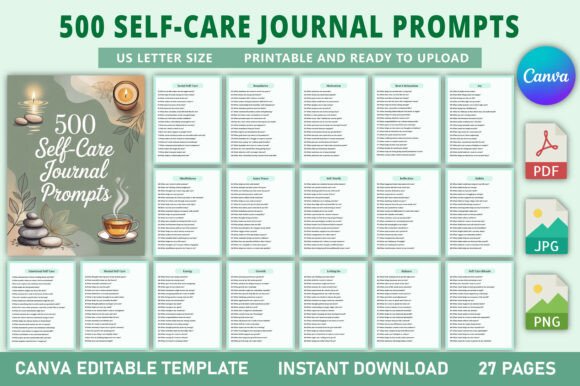
Most journal templates fall into two categories: overly prescriptive (rigid daily checklists) or too open-ended (vague prompts that invite avoidance). The 500 Self-Care Journal Prompts avoids both pitfalls by organizing prompts across 27 thematic pages—including Emotional Self-Care, Boundaries, Energy Management, Letting Go, and Self-Worth—not as isolated affirmations, but as diagnostic and developmental levers. Each section surfaces questions that reveal patterns: Where does your energy leak? When do you override intuition to meet external demands? What “self-care” habit actually drains you?
This structure supports decision-making—not just reflection. For example, an entrepreneur reviewing the Boundaries and Social Self-Care pages before launching a new offer may recognize recurring tension between accessibility and sustainability. That insight informs not just messaging (“I’m available M–F, 9–5”) but operational design (“I’ll batch client calls on Tues/Thurs only”). The prompts don’t prescribe answers—they surface data you already hold but rarely audit.
Strategic Use Cases Across Roles
The 500 Self-Care Journal Prompts delivers measurable utility when matched to specific goals:
- For creators and marketers: The Self-Discovery and Authentic Voice prompts help clarify positioning before building a brand voice guide or content calendar—reducing rework and increasing resonance.
- For educators and coaches: The Reflection and Habits sections support curriculum design by revealing where learners stall—not just what they forget, but how their self-perception blocks retention.
- For freelancers and small business owners: Energy and Rest & Relaxation prompts serve as early-warning systems. Tracking responses weekly helps identify unsustainable pricing models or scope creep before burnout triggers turnover or reputational risk.
- For publishers and KDP sellers: Because the interior is 100% editable in Canva—with no bleed, US Letter sizing, and KDP-tested formatting—you’re not buying a static product. You’re acquiring a production-ready asset that can be branded, localized, or segmented (e.g., “500 Self-Care Journal Prompts for Remote Workers” or “for New Parents”) without redesign overhead.
How to Use It Intentionally—Not Randomly
Opening to a random page and writing once won’t shift outcomes. The strategic value of the 500 Self-Care Journal Prompts emerges from deliberate sequencing and contextual anchoring. Consider these approaches:
- Quarterly Calibration: At the start of each quarter, spend 20 minutes on three targeted sections—e.g., Motivation, Balance, and Growth. Compare responses across quarters. Do your definitions of “growth” evolve? Does “balance” shift from equal time allocation to intentional trade-offs? These shifts inform goal-setting more accurately than generic OKRs.
- Pre-Major Decision Protocol: Before committing to a new project, hire, or partnership, complete prompts under Boundaries, Self-Worth, and Letting Go. If answers reveal hesitation masked as enthusiasm—or if “letting go” feels threatening rather than freeing—that’s critical context for negotiation or timeline adjustment.
- Team Integration (with consent): Select 2–3 prompts from Social Self-Care or Communication to seed team retrospectives. Not as therapy, but as operational diagnostics: “When did you last say ‘no’ to preserve capacity? What made that possible—or impossible?” Responses highlight systemic friction points (e.g., unclear escalation paths, reward structures that penalize boundary-setting).
Risks of Using It Without Context
Like any tool, the 500 Self-Care Journal Prompts can reinforce unhelpful patterns if applied without intention. Common misuses include:
- Treating prompts as performance metrics: Writing “I love myself” daily doesn’t build self-worth—it may deepen dissonance if lived experience contradicts the statement. Better: Use the Self-Compassion section to explore *what safety feels like physically* before layering in language.
- Isolating reflection from action: Noting “I feel drained by meetings” is useful only if followed by testing one structural change—e.g., moving all internal syncs to Wednesday AM, then measuring focus pre/post. The journal surfaces signals; you design the experiment.
- Over-customizing before validating need: Spending hours adjusting fonts and colors in Canva before testing even five prompts delays insight. First, use the ready-to-upload PDF to assess which sections resonate most. Then customize those pages—not the entire file.
Long-Term Value: From Prompt to Pattern
The highest ROI from the 500 Self-Care Journal Prompts isn’t in individual entries—it’s in recognizing recurrence. When Stress Relief prompts consistently point to unresolved conflict in a specific relationship, or Mindfulness responses repeatedly anchor to sensory grounding (not thought observation), you’re gathering evidence about your operating system. That evidence informs everything from hiring criteria (“Do I need someone who manages ambiguity well—or someone who structures it for me?”) to pricing strategy (“If my energy drops after 3 client calls, what’s the minimum viable rate per call to sustain that pace?”).
It also builds what’s often missing in high-output roles: self-trust. Not confidence born of success, but trust built through consistent attention—knowing, for example, that when motivation dips, returning to the Healing and Inner Peace sections reliably recalibrates your nervous system better than scrolling or caffeine. That reliability compounds. Over six months, it reduces decision fatigue. Over two years, it reshapes how you define sustainability—not as absence of stress, but as presence of alignment.
Final Strategic Note
The 500 Self-Care Journal Prompts is valuable precisely because it’s not a solution. It’s a mirror, a filter, and a tuning fork—all in one. Its power lies in how you choose to engage: as data collection, not diary keeping; as pattern recognition, not passive consumption; as infrastructure, not ornament. Whether you’re publishing on KDP, designing client resources, or rebuilding your own resilience after prolonged pressure—the prompts work best when treated as input, not output. They don’t replace strategy. They make strategy more accurate, more humane, and far more durable.