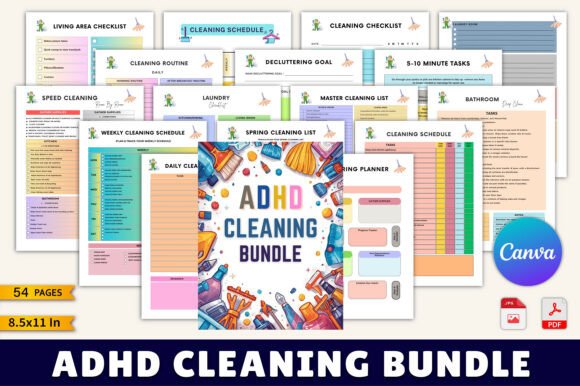
ADHD Cleaning Bundle
For adults managing ADHD—especially those juggling professional responsibilities, creative projects, family life, or small business operations—cleaning isn’t just about dirt or dust. It’s about cognitive load, executive function demands, and the cumulative toll of unstructured environments on focus, decision-making, and emotional regulation. The ADHD Cleaning Bundle responds to that reality not with more pressure, but with structure designed for how attention actually works: in bursts, with shifting priorities, and a need for clarity over complexity.
Why Structure Matters More Than Willpower
Traditional cleaning systems assume linear progress, sustained motivation, and predictable energy levels—none of which reliably align with ADHD neurology. When tasks lack clear entry points, defined scope, or built-in feedback loops, they stall—not from laziness, but from overload. The ADHD Cleaning Bundle replaces ambiguity with intentionality. Its daily, weekly, monthly, and yearly schedules don’t ask you to “just start.” They offer concrete starting points: *“Today: Wipe bathroom sink + refill hand soap”* or *“This week: Sort one kitchen drawer, 15 minutes max.”* That specificity lowers activation energy—the mental friction that often blocks action before it begins.
Strategic Use Across Roles and Responsibilities
A freelance designer working from home doesn’t clean to impress—they do it to protect creative bandwidth. A small business owner running a service-based operation needs predictable routines so administrative overhead doesn’t bleed into client work. An educator with young children needs systems that involve others without constant negotiation. In each case, the ADHD Cleaning Bundle functions less like a chore list and more like an operational framework—one that supports long-term outcomes by reducing daily friction.
Consider the Room-by-Room Checklists. For a blogger documenting home organization strategies, these aren’t just tools—they’re content scaffolding. Each checklist can become a reference point for tutorials, social posts, or email sequences grounded in real-world use. For a therapist supporting neurodivergent clients, the Decluttering Planners & Challenges provide evidence-based scaffolding for behavioral goals—breaking “organize garage” into seven 10-minute sessions with built-in reflection prompts.
When and How to Deploy the Bundle Intentionally
Using the ADHD Cleaning Bundle effectively requires alignment—not just with tasks, but with your current capacity, goals, and environment. Start by asking: What outcome am I protecting? Is it mental clarity before deep work? Consistency in shared household responsibility? Reliable inventory tracking for a home-based craft business? That answer determines where to begin.
- For time-limited professionals: Prioritize the Speed Cleaning Guides and Daily Schedules. These deliver immediate ROI—clear surfaces, functional spaces, reduced decision fatigue—without demanding hours.
- For households with multiple stakeholders: Leverage the Family Chore Charts alongside the Habit Tracker. Assign roles based on strengths (e.g., visual learners handle inventory logs; routine-oriented members manage maintenance reminders), not assumed responsibility.
- For creators building systems or courses: Use the Editable Canva Link and 54 Templates to adapt frameworks to your brand voice, audience needs, or teaching methodology—without rebuilding from scratch.
Avoiding the “Tool Trap”
Having the ADHD Cleaning Bundle doesn’t guarantee results—any more than owning a camera guarantees great photography. Risk emerges when tools are adopted without context: printing all 54 templates but never using one, treating checklists as moral tests instead of flexible guides, or expecting the Spring Deep Cleaning Checklists to resolve chronic disorganization without addressing underlying systems (e.g., mail intake, digital clutter, or supply storage).
Intentional use means editing—not just checking. Cross out steps irrelevant to your space. Combine overlapping tasks (“vacuum + wipe baseboards”). Add personal cues: *“Do this while listening to my favorite podcast”* or *“After I finish, I’ll brew tea and sit for five minutes.”* The bundle supports your rhythm—it doesn’t replace it.
Planning Beyond the First Week
The Home Maintenance Logs and Yearly Cleaning Schedules reveal the bundle’s longer-term strategic value. They shift focus from reactive cleanup to proactive stewardship—tracking HVAC filter changes, gutter cleaning, or pantry rotation dates. For entrepreneurs operating from home offices, this prevents costly oversights (e.g., mold from neglected bathroom ventilation) and reinforces professionalism through consistent, functional environments.
Similarly, the Home Inventory Sheets serve dual purposes: practical (no more last-minute grocery runs or supply shortages) and cognitive (reducing memory burden around recurring needs). For educators prepping classrooms or creators managing physical product inventory, this layer transforms passive accumulation into active resource management.
Design Choices That Support Real-World Use
The ADHD Cleaning Bundle avoids common pitfalls of productivity tools: overwhelming density, rigid formatting, or aesthetic overload. Its 8.5×11 page size ensures printability without scaling issues. The editable Canva link allows customization without design expertise—swap fonts, adjust colors, add your logo—making adoption feel personal, not prescriptive.
Crucially, the bundle includes both digital-ready PDFs *and* editable templates. That duality matters: some users thrive with tactile checklists taped to fridges; others need searchable, cloud-synced versions. Supporting both modalities acknowledges that neurodiversity extends beyond diagnosis—it lives in preference, habit, and context.
Building Habits Without Burnout
The Habit Tracker succeeds where many fail because it measures consistency—not perfection. A streak broken by travel, illness, or unexpected deadlines doesn’t reset progress. Instead, the tracker invites reflection: *What worked before the gap? What support would make re-entry easier?* That stance fosters self-awareness over shame—a prerequisite for sustainable change.
Pair it with the Decluttering Challenges, and you create compound momentum. Completing “Sort one shelf in 12 minutes” builds confidence that transfers to unrelated goals—negotiating contracts, launching a course module, or setting boundaries with clients. The cleaning process becomes rehearsal for broader executive function skills.
Final Strategic Consideration: Integration Over Isolation
The ADHD Cleaning Bundle delivers highest value when treated as part of a larger ecosystem—not a standalone fix. Integrate it with existing tools: paste habit tracker QR codes into your digital calendar; embed room checklists into Notion dashboards; link maintenance logs to shared family apps like Google Keep or Todoist.
And remember: its purpose isn’t spotless surfaces. It’s creating conditions where your attention, energy, and creativity flow with less resistance. Whether you’re drafting a grant proposal, filming a YouTube tutorial, managing client onboarding, or simply needing quiet space to think—the ADHD Cleaning Bundle provides architecture for calm, not chaos. It doesn’t ask you to change how your brain works. It meets you there—and helps you build what matters, one intentional step at a time.