Grandma, I Want to Hear Your Story Workbook: A Practical Guide for Capturing Family Legacy
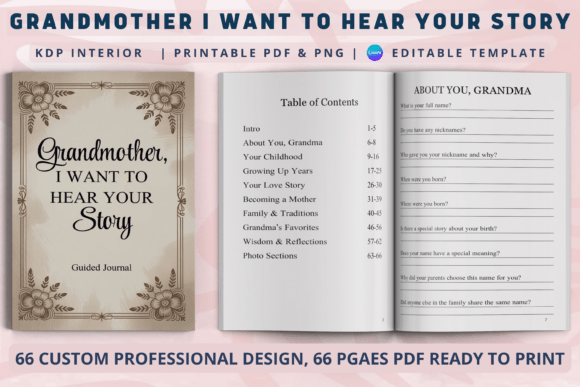
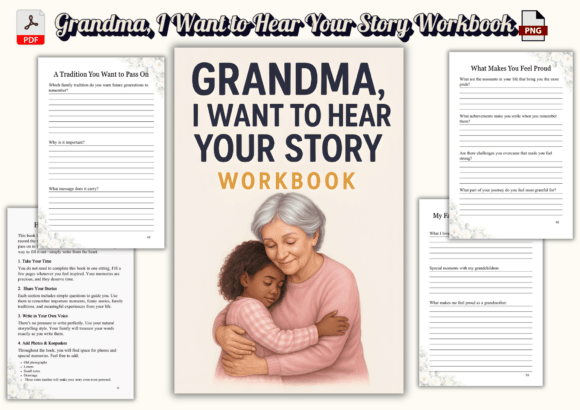
Preserving a grandmother’s voice—her laughter, her pauses, the way she tells a story about her first job or how she met Grandpa—is more than sentimentality. It’s an act of cultural preservation. Grandma, I Want to Hear Your Story Workbook is designed not as a generic journal but as a structured, empathetic tool that meets older adults where they are: with gentle prompts, ample space, and zero pressure to write like an author. At 69 pages and sized at 8.5 x 11 inches (US Letter), it balances depth with accessibility—long enough to cover meaningful life chapters, short enough to avoid overwhelm.
What Makes This Workbook Distinctive
Unlike blank journals or broad “life story” templates, Grandma, I Want to Hear Your Story Workbook organizes reflection around lived experience—not abstract themes. Its prompts progress chronologically and relationally: childhood neighborhoods, teenage friendships, early work experiences, courtship, raising children, adapting to change, and reflections on values passed down. Each section includes optional photo placeholders and open-ended questions that invite specificity (“What did your mother’s hands look like when she kneaded dough?”) rather than generalities (“Tell me about your mother”).
The inclusion of a fully editable Canva template link is a notable differentiator. Users can personalize fonts, colors, or layout before printing—or adapt it for digital sharing with family members who live far away. The high-resolution PDF and PNG files support both print-on-demand services and home printing, making it flexible across tech comfort levels. Importantly, the design avoids ornate embellishments or dense typography; instead, it uses generous line spacing, clear headings, and subtle visual cues to guide attention without distraction.
How It Compares With Other Approaches to Family Storytelling
Many people begin with good intentions—buying a leather-bound journal, recording voice memos, or asking questions during holiday visits—but struggle with consistency or depth. Grandma, I Want to Hear Your Story Workbook addresses two common gaps: structure and scaffolding. Voice recordings capture tone but often lack narrative cohesion; unstructured interviews may jump between decades without anchoring moments. In contrast, this workbook offers curated prompts that build context over time—e.g., following a question about school days with one about what music played in the background at home.
Compared to professionally facilitated oral history services (which often cost several hundred dollars and require scheduling multiple sessions), the workbook provides autonomy and pacing. A grandmother can complete one page per week—or skip sections entirely—without feeling rushed or evaluated. That said, it doesn’t replace skilled facilitation for complex topics like migration trauma, loss, or intergenerational conflict, where emotional safety and follow-up questions matter deeply.
It also differs from AI-powered storytelling tools that transcribe and summarize interviews. While those tools excel at efficiency, they often flatten nuance—the hesitation before answering, the shift in tone when recalling joy versus grief. Grandma, I Want to Hear Your Story Workbook preserves agency: the writer chooses what to share, how much detail to include, and whether to keep certain pages private.
Strengths and Realistic Tradeoffs
Its greatest strength lies in usability for non-writers. The prompts avoid academic language or prescriptive phrasing (“Describe your epiphany at age 23”) in favor of grounded, sensory invitations (“What smell reminds you most of your grandmother’s kitchen?”). This lowers barriers for people who haven’t written reflectively since school assignments.
A practical tradeoff is format limitation: it’s optimized for individual handwriting or light digital editing via Canva—not for collaborative writing across devices or real-time family input. If multiple grandchildren want to contribute questions or annotate responses, users would need to supplement with shared documents or scanned pages. Similarly, while the photo sections are thoughtful, they assume access to printed images or basic image-editing skills to insert them digitally.
Another consideration is scope. At 69 pages, it covers major life phases thoroughly but doesn’t delve into niche areas like military service, chronic illness journeys, or professional achievements in depth. Families wanting granular documentation of a specific chapter—say, nursing during the polio epidemic or running a small business through the 1970s recession—may need to add custom pages.
When This Workbook Fits—and When It Might Not
This resource shines when the goal is relational continuity: helping a grandmother articulate memories in her own voice, for her grandchildren to read decades later. It works well for families where English is the shared language and where the grandmother enjoys quiet reflection time. It’s especially valuable when timing matters—such as after a health diagnosis, during retirement transition, or ahead of planned travel that might separate generations.
It may be less suitable if the intended user has significant vision impairment (no large-print or audio version exists), advanced dementia (where short-term memory challenges make sustained reflection difficult), or strong resistance to writing by hand. In those cases, pairing the workbook with recorded conversations—using its prompts as an interview guide—can extend its usefulness without requiring independent completion.
Families comfortable with technology might also weigh whether a hybrid approach serves them better: using the workbook’s prompts during video calls, then compiling responses into a shared digital book or simple website. The editable Canva file makes that adaptation straightforward.
Practical Tips for Getting Started
Start small. Choose one section—perhaps “Your Favorite Childhood Game”—and spend 10 minutes together reading the prompt aloud, then letting her talk or jot down notes. No need to fill every line. Keep a pen and the workbook nearby during relaxed moments: afternoon tea, a Sunday drive, or while folding laundry.
If she prefers speaking over writing, use her answers as raw material. Type up her words verbatim later, then paste them into the Canva template alongside a photo. Even three completed pages create something tangible—a beginning.
Respect silences and sidesteps. Some prompts may stir discomfort or forgotten details. Let her skip, revisit later, or answer metaphorically (“My mother’s love felt like warm bread fresh from the oven”). The goal isn’t completeness—it’s authenticity.
Final Considerations for Thoughtful Decision-Making
Grandma, I Want to Hear Your Story Workbook sits at the intersection of intention and practicality. It won’t replace deep conversation, but it gives conversation shape. It won’t guarantee every memory surfaces, but it increases the likelihood that key ones do—especially those that might otherwise go unspoken until it’s too late.
For readers comparing options, ask: What’s the primary barrier right now? Is it lack of prompts? Difficulty starting? Uncertainty about how to preserve content long-term? If the answer is “I don’t know what to ask,” this workbook offers clarity. If the answer is “She won’t sit still for writing,” consider using it as a conversation framework instead. And if the priority is multimedia richness—video, music clips, scanned letters—this workbook complements those efforts but doesn’t replicate them.
Ultimately, legacy isn’t built in grand gestures. It lives in the details: the recipe scribbled on a napkin, the reason behind a family nickname, the quiet pride in learning to drive a tractor at sixteen. Grandma, I Want to Hear Your Story Workbook helps surface those details—not perfectly, not exhaustively, but meaningfully.