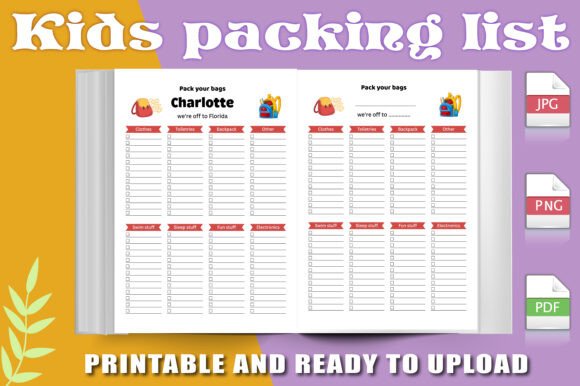
Kids Packing List
Traveling with children introduces a unique set of logistical and emotional considerations — from managing expectations to ensuring comfort, safety, and engagement. A well-designed Kids Packing List isn’t just a checklist; it’s a practical tool that supports independence, reduces pre-trip anxiety, and helps families align on responsibilities before departure. Unlike generic packing lists or adult-oriented templates, the Kids Packing List is built specifically for young travelers aged 4–12, balancing structure with age-appropriate flexibility.
What Makes This Kids Packing List Distinct?
The Kids Packing List stands out through intentional design choices grounded in child development principles and real-world travel experience. Its A4 (8.3 × 11.7 inch) printable format uses clear visual categories — not dense paragraphs — so children can recognize sections by icon and color rather than reading fluency. Repetition across categories (e.g., “socks” appears under both Clothing and Sleep Stuff) reinforces memory without overloading. Each section maps to a functional travel need: Swim Gear reminds kids of goggles and flip-flops; Backpack Items highlights what stays accessible during transit; Fun Entertainment includes space for drawing favorite toys or writing book titles.
Unlike digital-only apps or complex spreadsheets, this list is intentionally low-tech and tactile. The editable Canva template allows caregivers to adjust wording or add destination-specific items (e.g., “snow boots” for a Colorado ski trip), while the print-ready PDF ensures consistency across devices and settings — no login required, no battery drain, no app updates.
How It Compares With Other Approaches
Many families rely on informal methods: scribbled notes on scrap paper, shared Google Docs, or verbal reminders. These work for some, but they often lack scaffolding for emerging self-management skills. A handwritten list may be lost or misread; a collaborative doc requires tech access and adult oversight at every step. In contrast, the Kids Packing List provides consistent visual cues and physical interaction — crossing off items with a pencil builds motor skills and offers tangible progress feedback.
Compared to commercially available laminated checklists or subscription-based travel planners, this resource avoids recurring costs and vendor lock-in. It doesn’t require scanning QR codes or syncing cloud accounts. Instead, it meets families where they are: printing once means having a reusable framework for multiple trips — whether it’s a weekend visit to grandparents or a two-week Florida vacation.
Some parents use photo-based lists (e.g., printed images of each item), which are effective for early learners but less scalable for longer trips or varied wardrobes. The Kids Packing List bridges that gap: illustrations support recognition, while text labels gently scaffold literacy. It also includes a customizable Destination Area — a small but meaningful detail that helps children connect abstract planning (“we’re going somewhere”) with concrete action (“I’m packing for Orlando”).
Strengths and Practical Tradeoffs
One of the strongest advantages is its adaptability across trip types and durations. Because clothing is organized by “days of travel” rather than fixed quantities, families can scale up or down without redesigning the entire list. For a three-day beach trip, a child might pack one swimsuit and two cover-ups; for a ten-day road trip, the same layout accommodates layered outfits and extra swim gear — all within the same familiar structure.
However, the list does assume a baseline level of caregiver involvement. It’s not fully autonomous — younger children will still need help interpreting “toiletries” or selecting appropriate footwear for weather. That’s by design: the goal is guided independence, not full delegation. Families seeking a completely hands-off solution may find it requires more initial setup than plug-and-play digital tools.
Another consideration is regional formatting. While the PDF is optimized for standard A4 and US Letter sizes, minor cropping or scaling may occur when printing from certain browsers or mobile devices. Testing a single page first is advisable — especially if using school printers or older multifunction machines.
When This Kids Packing List Fits Best
This resource works especially well for families prioritizing routine-building and skill development over speed or automation. If your goal is to help your child gradually take ownership of their travel prep — starting with choosing books, then adding toiletries, then progressing to matching outfits — the Kids Packing List provides the right balance of guidance and space to grow.
It’s also ideal for mixed-age households. Older siblings can use the same template with added notes (e.g., “charged power bank” under Electronics), while younger ones focus on stickers or drawings in the Fun Entertainment section. Teachers and camp coordinators have adapted it for group travel prep, using the editable Canva version to embed program-specific items like “name tags” or “canteen cup.”
Families traveling internationally or to remote locations may want to pair it with supplemental resources — such as a separate medication log or customs declaration checklist — since the Kids Packing List focuses exclusively on personal belongings and comfort items, not documentation or regulatory requirements.
Realistic Use Cases and Adjustments
In practice, one family used the Kids Packing List for a six-day trip to Florida. Their 7-year-old checked off items daily during prep week, using colored pencils to mark completed sections. They added “flip-flops for pool deck” and “sun hat with strap” in the Customizable Destination Area — small but critical additions based on past experience with blown-away hats. The Toiletries Section helped them spot an oversight: sunscreen was listed, but lip balm with SPF wasn’t — prompting a quick revision before printing the final copy.
Another parent modified the Swim Gear section for a winter ski trip, replacing “beach towel” with “microfiber drying cloth” and adding “hand warmers” under Fun Entertainment (since her daughter associated them with cozy fun). These tweaks were possible because the Canva template supports easy text edits — no graphic design skills needed.
What to Consider Before Choosing
If your child thrives on gamified motivation — points, badges, or audio prompts — a digital checklist app may offer more immediate reinforcement. Similarly, if you frequently travel with infants or toddlers who require specialized gear (e.g., bottle sterilizers, portable cribs), you’ll likely need to supplement the Kids Packing List with a second, caregiver-focused document.
Also consider storage and portability. While the A4 size is convenient for wall display or clipboard use, it’s less practical for tight carry-on spaces. Some users trim margins or print two-up per page for compact folding — a simple workaround enabled by the high-resolution PDF.
Making an Informed Choice
Ultimately, the value of the Kids Packing List lies in how well it aligns with your family’s rhythm, goals, and capacity. It’s not about eliminating effort — it’s about redirecting energy toward connection and capability instead of last-minute scrambles. When compared with alternatives, it excels in clarity, consistency, and developmental appropriateness — especially for children beginning to explore responsibility in manageable increments.
Before deciding, ask yourself: Do we benefit more from physical interaction with planning tools? Are we aiming to build long-term habits, not just solve next week’s trip? Is simplicity — across devices, ages, and settings — more valuable than feature richness? If the answer to most of those is yes, the Kids Packing List is worth integrating into your travel routine.