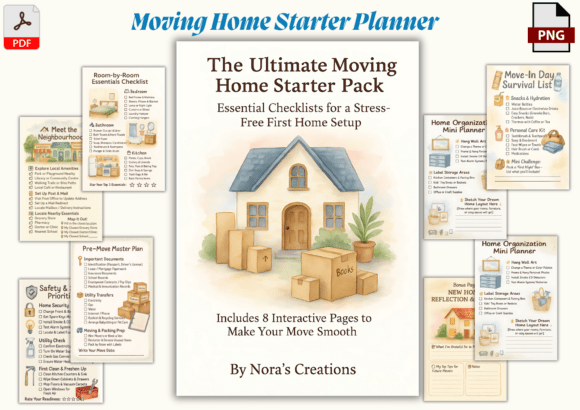
Moving Home Starter Planner: Your Calm, Creative Companion for Any Move
Let’s be real—moving isn’t just about boxes and bubble wrap. It’s the late-night Google searches (“how do I transfer my electricity?”), the frantic text to your sister asking, “Did we label the box with the coffee maker?”, and that moment you stand in an empty living room on move-in day wondering where to even begin unpacking. The Moving Home Starter Planner was made for *that* version of you—the one who wants order without overwhelm, practicality without plainness, and calm without compromise.
What This Isn’t (and What It Truly Is)
This isn’t a generic to-do list buried in a 50-page PDF. It’s not a rigid schedule that assumes you’ll pack exactly three hours every Tuesday. And it’s definitely not a one-size-fits-all spreadsheet that makes your eyes glaze over before Day 1.
The Moving Home Starter Planner is a thoughtfully designed, 10-page watercolour printable—soft-hued, intuitive, and deeply human. It meets you where you are: whether you’re handing over keys to your first flat, downsizing after 28 years, helping your elderly parent relocate, or gifting a thoughtful, usable welcome-to-the-neighborhood present. Its strength lies in its quiet flexibility—it guides without dictating, inspires without pressuring, and organises without erasing your personality.
When Real Life Makes This Planner Indispensable
First-time renters in their mid-20s: You’ve signed the lease—but now what? Do you need a landline? How soon should you set up internet? Where do you even *start* with utility transfers? The Pre-Move Master Checklist walks you through essentials in plain language—not jargon—and includes gentle prompts like “✅ Confirm pet deposit policy” or “✅ Test smoke detector batteries *before* you leave your old place.” It’s the friend who remembers the small things so you don’t have to.
New homeowners closing next week: That post-closing rush—changing locks, scheduling deep cleaning, updating your address with the DMV—isn’t glamorous, but it’s critical. The Safety Setup Guide helps you prioritise what needs doing *immediately* (like securing entry points) versus what can wait until weekend two (like rearranging shelves). One user told us she printed just that page and taped it to her fridge—“It stopped me from Googling ‘how to reset garage door code’ at 10 p.m. on moving day.”
Parents moving with young kids: Chaos is part of the package—but it doesn’t have to mean total disarray. The Room-by-Room Essentials lists let you break down packing by function, not just location. “Kitchen” includes not just “pots & pans” but “kids’ lunchboxes + reusable snack bags”—a tiny detail that saves 17 minutes of frantic searching on Day 1. And the Move-In Day Survival List? Think: toddler-friendly snacks, a small comfort toy, hand sanitiser, and a fully charged power bank—not just “toothbrush and towel.”
Realtors and property managers: Gifting this planner as a closing gift does more than look nice—it builds trust. Clients remember how supported they felt *after* the sale closed. One Toronto agent shared that since adding the Moving Home Starter Planner to her welcome kit, she’s had three repeat referrals from clients who said, “That little planner got me through the first week without crying.” It’s professional, warm, and quietly brand-building.
Who Else Finds Unexpected Value in These Pages?
- Professional organisers: They use the Cleaning Zones section and wall art layout tips as conversation starters—not scripts. It gives clients visual language to talk about space, rhythm, and intention—not just “more storage.”
- DIY planners and journal lovers: The watercolour aesthetic isn’t just pretty—it’s purposeful. Soft edges and gentle tones lower cognitive load. You’re more likely to open it, write in it, and return to it when it feels like a companion, not a chore.
- Caregivers coordinating a senior move: The “What NOT To Do” page is unexpectedly powerful here. Phrases like “Don’t assume all meds transfer smoothly between pharmacies” or “Don’t pack important documents in moving boxes—carry them yourself” come from lived experience, not theory.
- Remote workers relocating across states: The Meet the Neighbourhood map isn’t just for coffee shops—it’s for walkability scores, pharmacy proximity, and even noting “quiet street for video calls.” It turns orientation into intention.
Things to Keep in Mind Before You Print (or Gift)
This planner shines brightest when used *alongside* real-world action—not instead of it. It won’t auto-schedule your U-Haul or negotiate your renter’s insurance deductible. But it *will* help you remember to call your insurer *before* you cancel your old policy. It won’t pack your books—but it will suggest grouping them by frequency of use so your most-loved novels land in your hands on Night One.
It’s designed for printing at home (6x9 inches fits standard letter paper with easy trimming), but it’s also screen-friendly. Many users keep the PDF open on a tablet while walking through rooms, checking off items with a stylus. Just know: the reflection page and gratitude notes work best with pen-on-paper. There’s something grounding about handwriting “I’m proud I handled the cable company call calmly” in soft blue ink.
Also worth noting: because it’s a printable PDF, there’s no subscription, no login, and no algorithm deciding what you “should” see next. It belongs to you—fully, quietly, permanently. No updates will change the layout. No notifications will pop up. It’s yours to adapt, annotate, and even colour in if you feel like it.
Why “Stylish” Matters More Than You Think
Let’s pause on that watercolour cover—a cozy illustration of house-shaped boxes, soft greens and warm terracottas. It’s not just decoration. When your brain is flooded with logistical noise, beauty acts as an anchor. Choosing a planner that feels good to hold, to flip through, to display on your desk—it signals permission to slow down, breathe, and treat this transition as meaningful, not just mechanical.
That’s the quiet magic of the Moving Home Starter Planner. It doesn’t erase the stress of moving. But it wraps practical tools in warmth—so you don’t just survive the move. You settle in with presence. You unpack with purpose. And somewhere between the checklist and the gratitude note, you remember: this isn’t just a change of address. It’s the beginning of a new chapter—one you’re ready to step into, calmly and completely.