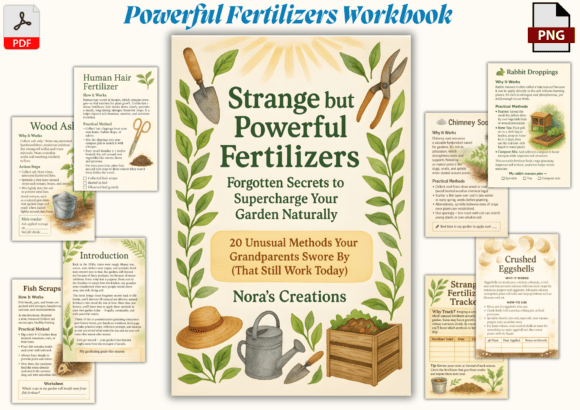
Powerful Fertilizers Workbookn Ebook
You don’t need synthetic chemicals to grow vibrant, resilient plants. You need curiosity—and the right tools to turn overlooked resources into soil vitality. The Powerful Fertilizers Workbookn Ebook is that tool: a compact, 24-page interactive guide rooted in real historical practice and designed for modern hands-on learning.
It’s not another dense gardening manual. It’s a tactile, watercolor-illustrated workbook—6x9 inches, print-ready, digitally flexible—that invites you to experiment, track, reflect, and adapt. Each page balances inspiration with action: a forgotten fertilizer method (like crushed eggshells steeped in vinegar or fermented banana peels), clear step-by-step instructions, space to log observations, and gentle prompts that connect technique to outcome.
Why “Strange” Works—And Why It’s Not Just Quirky
The title Strange but Powerful Fertilizers isn’t clickbait—it’s precision. Hair clippings, fish guts, molasses, stale beer, even human urine (diluted and aged) were routinely used in 1930s home gardens—not because they were trendy, but because they delivered measurable results. These materials weren’t “weird” to gardeners of that era; they were *available*, *free*, and *effective*.
What makes them powerful today isn’t nostalgia—it’s nutrient density and microbial activity. Fish guts break down into rich nitrogen and trace minerals. Seaweed delivers over 60 trace elements and natural growth hormones like auxins and cytokinins. Molasses feeds beneficial soil bacteria that unlock phosphorus and potassium already present in your soil. The “strange” is simply what industrial agriculture trained us to discard.
A Workbook Designed for Real Use—Not Shelf Decor
This isn’t a PDF you download and forget. It’s built for engagement:
- Interactive trackers for compost batches, manure tea brewing timelines, and plant response logs help you see patterns—not just guess at what worked.
- Historical sidebars contextualize each method—not as folklore, but as documented practice from extension bulletins, homesteading diaries, and USDA reports of the 1930s.
- Reflection pages prompt you to note texture changes in soil, pest pressure shifts, or bloom timing—building your own localized knowledge base over time.
- Eco-gardening certificate isn’t just symbolic. It’s a completion marker you can use in workshops, classroom settings, or community garden programs to recognize applied learning.
The 300 DPI PNG files mean you can drop individual pages directly into Canva, Notion, or Google Slides—ideal for educators building lesson plans, content creators designing social posts, or small farms developing staff training decks.
Creative Applications Beyond the Backyard
The Powerful Fertilizers Workbookn Ebook scales thoughtfully across roles and platforms:
For Educators & Community Organizers
Use the seaweed or comfrey leaf tea recipes in after-school science units. Pair the soil log pages with local soil testing kits to ground abstract concepts like pH, cation exchange, or microbial diversity in tangible observation. The watercolor illustrations lower visual barriers for younger learners or multilingual audiences.
For Content Creators & Bloggers
Each fertilizer method is a ready-made content pillar: “Molasses Tea: Why This Kitchen Staple Boosts Tomato Yields (and How I Tested It Over 8 Weeks).” The workbook’s trackers give you authentic data points—not just opinions—to back up claims. Repurpose the PNGs as Instagram carousels, Pinterest infographics, or printable workshop handouts—no design license needed.
For Small Business Owners & Homesteaders
Turn the fish gut or poultry feather fertilizer recipes into value-added offerings: pre-mixed organic amendments, DIY kit subscriptions, or on-farm workshops. The certificate page becomes a branded credential for participants—reinforcing your authority while encouraging repeat engagement.
For Designers & Publishers
The clean 6x9 layout and consistent watercolor aesthetic make it easy to rebrand or extend. Add your logo to the cover, swap in custom tracker fields for specific crops (e.g., “Kale Growth Tracker” or “Berry Vine Response Log”), or bundle it with your seed catalog as a premium digital bonus. Because it’s delivered as both PDF and individual PNGs, you retain full flexibility for print-on-demand, app integration, or LMS uploads.
Practical Tips for Getting Started—Without Overwhelm
You don’t need to try all 20 methods at once. Start with one that matches your current waste stream:
- If you cook fish weekly → begin with fish emulsion tea. The workbook gives exact ratios, fermentation timelines, and odor-control tips (hint: add citrus rinds or dried mint).
- If your kitchen overflows with banana peels → try banana peel vinegar extract. It takes 3 weeks, but the result is a potassium-rich foliar spray you can use on tomatoes, peppers, and flowering perennials.
- If you have access to fresh seaweed (even washed-up kelp from a beach walk) → use the seaweed soak method. No boiling required—just steep, strain, and dilute. Track leaf gloss and stem strength before and after application.
Keep your first round simple: pick one method, one plant type, and one metric (e.g., “days to first flower,” “number of new leaves per week,” or “soil moisture retention after watering”). Use the reflection pages—not to judge success, but to notice cause and effect. That habit alone builds deeper horticultural intuition than any generic advice ever could.
What Makes This More Than Just Another Ebook
It bridges three gaps most gardening resources ignore:
- Knowledge-to-action gap: Recipes include prep time, shelf life, safety notes (e.g., “do not apply fresh urine to seedlings”), and substitution options (e.g., “if you can’t find comfrey, use chopped dandelion roots instead”).
- Historical-to-practical gap: It doesn’t romanticize the past—it extracts replicable techniques tested under real constraints (limited transport, no refrigeration, reliance on seasonal abundance).
- Individual-to-community gap: The trackers and logs create portable data. Share anonymized results in local gardening groups, compare notes across regions, or contribute to open-source soil health projects.
The Powerful Fertilizers Workbookn Ebook works because it treats soil not as a passive medium, but as a living system you learn to converse with—one strange, powerful, deeply practical ingredient at a time.