My Feelings Book for Kids: A Playful, Powerful Tool for Emotional Growth
Every child experiences big emotions — joy that bubbles over, frustration that leads to tears, fear before the first day of school, or quiet sadness after saying goodbye. But understanding those feelings? Naming them? Knowing what to do with them? That’s where emotional intelligence begins — and My Feelings Book for Kids steps in as a gentle, joyful, and research-informed guide.
Why Emotional Awareness Matters — More Than Ever
In today’s fast-paced, digitally saturated world, children are exposed to complex social dynamics, academic pressures, and constant sensory input — often before their brains have fully developed the tools to process it. According to the Collaborative for Academic, Social, and Emotional Learning (CASEL), children with strong emotional awareness show improved attention, better decision-making, stronger relationships, and higher academic engagement.
Yet many adults — parents, teachers, even therapists — struggle to explain abstract emotional concepts to young minds. That’s where a well-designed, age-appropriate resource like My Feelings Book for Kids makes a real difference. It doesn’t just label emotions — it invites children to explore them through play, art, reflection, and choice.
What Exactly Is My Feelings Book for Kids?
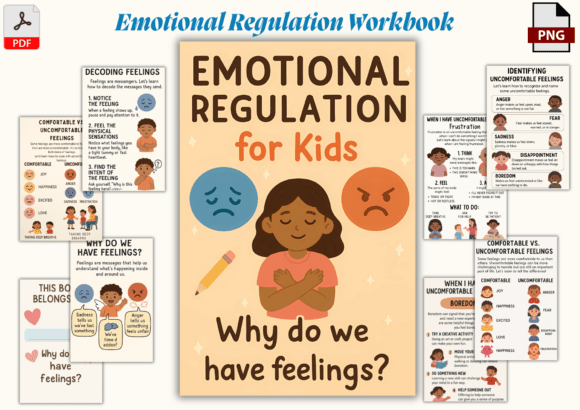
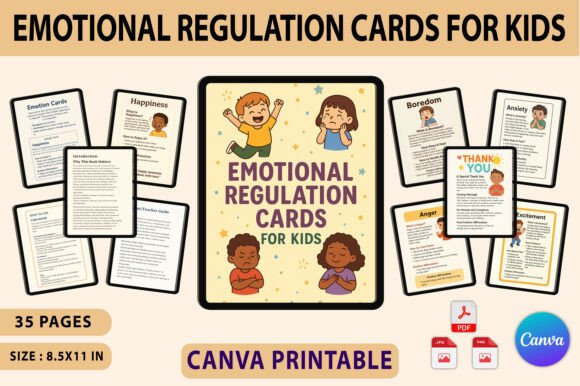
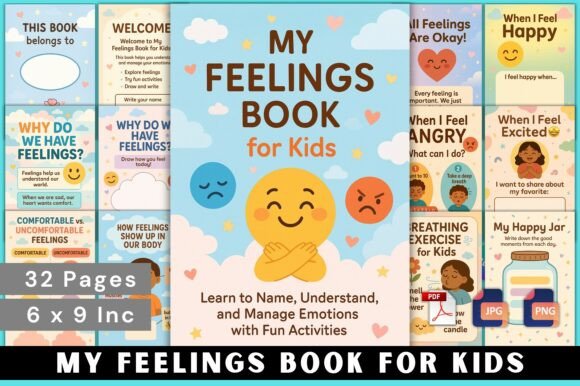
My Feelings Book for Kids is a 32-page printable emotional awareness workbook designed specifically for children ages 4 to 9. Measuring a child-friendly 6 x 9 inches, its compact size fits perfectly on small desks, therapy tables, or cozy reading nooks. With vibrant illustrations, open-ended prompts, and hands-on activities, it transforms emotional learning from abstract theory into tangible experience.
Unlike traditional worksheets that focus only on “right answers,” this workbook honors each child’s unique emotional landscape. There are no wrong ways to draw “what anger looks like” — only opportunities to notice, name, and begin to understand.
1. Emotion Exploration — Beyond “Happy” and “Sad”
The workbook introduces core emotions — happiness, sadness, anger, fear, surprise, and calm — but goes further by including nuanced states like shyness, excitement, disappointment, and pride. Each emotion gets its own guided page featuring:
- A simple, child-friendly definition (“Fear helps keep me safe when something feels unknown”)
- A relatable scenario (“Have you ever felt scared before a thunderstorm?”)
- A space to draw or color how that feeling shows up in their body
This approach aligns with modern developmental psychology, which emphasizes that emotional literacy starts with recognition — not judgment.
2. Creative Expression — Where Art Meets Awareness
Children don’t always have the words to describe how they feel — but they often *do* have crayons, markers, or fingers ready to scribble. Drawing, coloring, and matching exercises in My Feelings Book give kids nonverbal pathways to express inner experiences. For example, one page asks: “Draw a time you felt proud — what were you doing? Who was there?” Another invites them to match facial expressions with emotion names — building visual literacy alongside emotional vocabulary.
3. Emotional Regulation Tools — Simple Strategies, Lifelong Impact
Knowing *what* you feel is step one. Knowing *what to do* is step two — and this workbook supports both. Pages include gentle prompts like:
- “When I feel angry, my body feels ______. I can take three slow breaths.”
- “One thing that helps me feel calm is ______.”
- “I can ask for help when I feel ______.”
These aren’t rigid scripts — they’re invitations to practice self-advocacy and co-regulation. Teachers use these pages during morning meetings; counselors incorporate them into trauma-informed sessions; parents revisit them during quiet moments after meltdowns or transitions.
4. Positive Mindset Prompts — Building Confidence, Not Just Calm
Emotional health isn’t just about managing “negative” feelings — it’s also about nurturing resilience, kindness, and self-worth. The workbook includes affirming questions such as:
- “What’s one thing I’m really good at?”
- “Who makes me feel loved — and how do I show love back?”
- “What made me smile today?”
These prompts foster gratitude, perspective-taking, and secure attachment — all foundational to long-term well-being.
5. Classroom-Ready Design — Flexible for Any Setting
Whether used in preschool circle time, elementary SEL (Social-Emotional Learning) curricula, speech-language therapy, occupational therapy, homeschool routines, or clinical play-based interventions, My Feelings Book adapts seamlessly. Its clean layout, minimal text, and high-contrast visuals support neurodiverse learners, including children with ADHD, autism, or language delays.
Many educators report using one page per week — pairing it with read-alouds like The Color Monster or In My Heart — while therapists integrate pages into goal-tracking systems for emotional identification and regulation benchmarks.
6. Instant Access — Practical for Busy Adults
No shipping delays. No waiting for curriculum approvals. Just download the high-quality PDF (plus PNG and JPG files for digital whiteboards or tablets), print, and go. The file is optimized for home printers — crisp lines, vibrant colors, and kid-safe margins — making it ideal for caregivers who need reliable, low-prep tools.
Common Misconceptions — Clarified
Myth: “Emotional workbooks are only for kids with behavioral challenges.”
Truth: Emotional awareness benefits *every* child — just like learning letters benefits every reader. Early exposure builds preventative skills, not just reactive fixes.
Myth: “Young kids can’t understand complex feelings.”
Truth: Children as young as 2 begin identifying basic emotions — and by age 4–5, they can discuss causes and consequences. What they need isn’t simplification — it’s scaffolding. This workbook provides exactly that.
Myth: “Printables replace meaningful adult connection.”
Truth: Far from it. The most powerful moments happen when an adult sits beside a child, asks open-ended questions (“Tell me about your drawing”), and listens without fixing. My Feelings Book serves as a bridge — not a substitute — for those vital conversations.
Real-Life Impact: From Home to School to Therapy
A kindergarten teacher in Portland shared how her students now use the “Feeling Weather Report” page each morning — choosing sun (happy), storm cloud (frustrated), rainbow (hopeful), or fog (confused). It’s become a ritual that reduces transition anxiety and gives her real-time insight into classroom emotional climate.
A parent in Austin noticed her 6-year-old began naming feelings aloud after completing the “Body Scan” activity: “Mom, my fists are tight — I think I’m feeling angry.” That simple sentence marked a turning point in their communication.
In pediatric occupational therapy clinics, clinicians use the matching and drawing pages to assess interoceptive awareness — a key predictor of self-regulation success.
Your Next Step Toward Emotional Connection
My Feelings Book for Kids isn’t just another printable. It’s a compassionate, evidence-aligned companion for raising emotionally intelligent, empathetic, and resilient human beings. Whether you're a parent seeking deeper connection, an educator building inclusive classrooms, or a therapist supporting healing through expression — this workbook meets you where you are.
With its blend of creativity, cognitive scaffolding, and heart-centered design, it turns emotional learning into something warm, accessible, and genuinely fun. Because when children learn to honor their inner world, they grow not only smarter — but kinder, braver, and more fully themselves.