2026 Kids’ Travel Journal
For families, educators, and creative professionals who support children’s learning through experience—not just instruction—the 2026 Kids’ Travel Journal stands out as a thoughtfully structured, activity-driven tool that bridges travel, reflection, and skill-building. Unlike generic blank notebooks or overly prescriptive planners, this journal is built around developmental appropriateness: it scaffolds observation, organization, cultural curiosity, and self-expression without sacrificing flexibility or visual appeal.
A Practical Framework for Real-World Learning
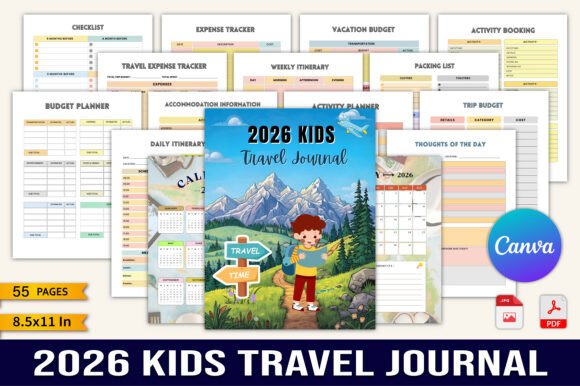
The 2026 Kids’ Travel Journal organizes its 55 pages into functional categories—calendar tracking, pre-trip planning, on-the-go documentation, and post-trip reflection—each serving a distinct cognitive or logistical purpose. The 2026 calendar overview isn’t decorative; it functions as a visual anchor for long-term trip anticipation and time awareness, especially helpful for children developing executive function skills. Pre-travel checklists (packing, documents, permissions) reduce last-minute stress for caregivers while giving kids agency over preparation—a subtle but meaningful shift from passive participant to co-planner.
Trip planner pages go beyond destination names: they include space for budget estimates, daily itinerary blocks, and even weather notes. This supports early numeracy, sequencing, and cause-effect reasoning. In practice, a 9-year-old might estimate train fare in euros, sketch a map of a museum layout, or compare local ice cream prices across three cities—small actions that reinforce math, geography, and critical thinking in context.
Design That Serves Purpose—Not Just Aesthetics
The journal’s 8.5×11-inch page size strikes a practical balance: large enough for drawing and photo pasting, compact enough for road-trip portability. Its editable Canva link and high-quality PDF files mean users can adapt content before printing—adding school logos for field trip use, translating prompts for bilingual learners, or adjusting font size for younger writers. The 55 Canva templates aren’t interchangeable decorations; they’re modular components. An educator leading a summer cultural exchange might use the “Country Culture Pages” to compare flags and currencies before departure, then switch to “Memory Pages” with photo placeholders during the trip, and conclude with “Travel Bucket List” reflections back home.
Color and layout are consistent but not overwhelming. Icons (🧭, 🏖️, 💰) serve as visual cues—not gimmicks—and support independent navigation for readers aged 6–12. Doodle zones and coloring spaces aren’t filler; they provide low-pressure outlets for processing sensory input—especially useful after busy days or for neurodivergent children who benefit from multimodal expression.
Teaching Financial Literacy Without Lecturing
The expense tracker is one of the journal’s most quietly effective features. Rather than abstract lessons about money, it asks kids to record real transactions: bus tickets, snack purchases, souvenir costs—with optional columns for currency conversion. Over a two-week trip, patterns emerge: “I spent more on drinks than souvenirs,” or “This city’s public transport was cheaper than the last.” These observations build financial literacy organically—no worksheets required. For homeschoolers or afterschool program coordinators, this section integrates seamlessly into project-based learning units on economics or global citizenship.
Cultural Engagement Beyond Surface-Level Facts
The “Country Culture Pages” avoid tokenism. Instead of listing “fun facts,” they prompt comparative questions: “What words did you hear most often?” “How do people greet each other here?” “What food smelled strongest at the market?” These open-ended prompts invite observation over memorization—aligning with best practices in intercultural education. When used consistently across multiple trips, the journal becomes a longitudinal record of evolving perspective: a child’s first entry about Japan may focus on sushi and anime; by age 12, the same page might reflect on language barriers, public etiquette, or regional dialect differences.
Who Benefits—and Where It Fits Naturally
The 2026 Kids’ Travel Journal works best when integrated—not assigned. Families using it on road trips report higher engagement during downtime (rest stops, hotel evenings) because the tasks feel like play, not homework. Educators incorporate it into geography units, service-learning projects, or international pen-pal exchanges. Small business owners running kid-focused travel services (e.g., family tour operators or museum educators) use printed versions as branded takeaways—customized with their logo and local tips on the back cover.
It’s less suited for highly structured group tours where schedules leave little room for reflection, or for children under 6 without adult support. While the journal includes drawing space, it assumes basic fine motor control—so younger users benefit most with guided assistance. Also, the editable Canva files require basic familiarity with Canva’s interface; those unfamiliar may need 15–20 minutes to learn resizing text boxes or swapping icons before printing.
Long-Term Value and Physical Durability
Printed on standard 24–28 lb paper, the PDFs hold up well to glue, markers, and light watercolor—though heavy washes may bleed. Spiral binding isn’t included, so users opting for physical copies should consider coil or comb binding for lay-flat usability. As a keepsake, its chronological structure and visual variety make it more likely to be revisited than a stack of photos alone. Parents note that children return to past journals before new trips—not to reread text, but to flip through sketches, ticket stubs, and handwritten notes, reinforcing memory consolidation and narrative identity.
Realistic Integration Tips
- Start small: Use only the calendar and one memory page on a weekend outing before scaling up to multi-day trips.
- Model, don’t mandate: Adults filling out their own parallel journal (even briefly) increases buy-in far more than instructions alone.
- Leverage the editable files: Add your city’s public transit map to the “Trip Planner” page, or insert a photo of your school mascot on the cover for classroom use.
- Repurpose sections: The “Travel Bucket List” doubles as a goal-setting tool for non-travel contexts—like trying new foods, meeting neighbors, or learning phrases in a heritage language.
In an era where screen-based documentation dominates, the 2026 Kids’ Travel Journal offers something increasingly rare: sustained, tactile engagement with experience. It doesn’t replace digital tools—it complements them. A child might snap a photo on a tablet, then paste a printout into the journal while describing why that moment mattered. That combination—immediacy plus reflection—is where real learning takes root. For professionals supporting children’s growth, whether in homes, classrooms, or community programs, this journal delivers measurable utility without overpromising. It’s not about creating perfect records. It’s about making space—on the page and in the mind—for curiosity to unfold, one trip at a time.