300 Mental Health Journal Prompts
Journaling isn’t just about writing—it’s about listening. Listening to your thoughts, honoring your emotions, and making space for healing without judgment. The 300 Mental Health Journal Prompts is a thoughtfully designed digital wellness tool that turns reflection into practice. It’s not a rigid workbook or a clinical manual. Instead, it’s a flexible, compassionate companion—offering 300 distinct prompts organized across nine meaningful themes, from emotional awareness to future visioning.
What Makes These Prompts Different?
Most journaling resources offer a handful of generic questions. This collection stands out because every prompt serves a specific emotional or cognitive purpose—and none are repeated. You’ll find prompts like “What sensation shows up in my body when I feel unseen?” (for emotional awareness), or “Write a letter to your anxious self—as if you were speaking to a dear friend” (for self-compassion). Others gently guide trauma reflection, mindfulness anchoring, or gratitude reconnection—not as prescriptions, but as invitations.
Who Benefits—and Why?
This resource supports people who want to build mental wellness habits without overwhelm. A freelancer juggling deadlines and isolation might use the Rest & Self-Care Routines section to design realistic wind-down rituals. An educator recovering from burnout could turn to Anxiety Stress Relief prompts before class to ground themselves. A small business owner navigating imposter syndrome may revisit Confidence & Joy prompts weekly to reinforce self-worth beyond metrics.
It’s especially helpful for beginners because there’s no “right” way to begin—just open to any page and respond however feels true. No analysis required. No pressure to write pages. Even three minutes with one prompt can shift perspective.
Real-Life Uses Across Contexts
- Creative professionals: Use the Mindfulness Presence prompts during creative blocks to reconnect with sensory detail and reduce perfectionism.
- Remote workers: Integrate Rest & Sleep Routines prompts into evening reflections to separate work identity from personal time.
- Educators & coaches: Adapt prompts (with attribution) into student wellness check-ins or client sessions—especially the Future Visioning section for goal-setting conversations.
- Content creators: Pull inspiration from the Joy & Gratitude prompts to craft authentic social posts or newsletter reflections.
- Therapy-adjacent support: While not a replacement for clinical care, many users share how these prompts help them prepare for therapy sessions—or process insights between appointments.
Designed for Flexibility—Not Perfection
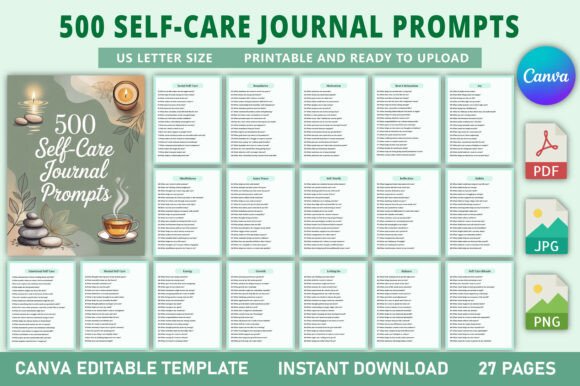
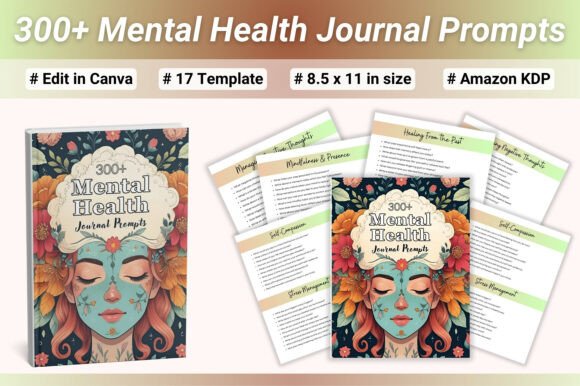
The 300 Mental Health Journal Prompts comes as an instant digital download with multiple formats: a print-ready PDF (US Letter, 300 dpi, no bleed), high-res JPGs, transparent PNGs, and a fully editable Canva template. That means you can print at home, order a spiral-bound version, paste prompts into Notion or Obsidian, or even embed them into a custom app or course module.
Each of the 17 page layouts balances whitespace, gentle typography, and intuitive flow—no clutter, no distractions. There’s no branding on the interior pages, so your focus stays on your words, not the design.
Beginner-Friendly Starting Points
If you’re new to journaling, try this: pick *one* theme that feels most relevant right now—say, Self-Compassion Healing. Choose a prompt that resonates—even if it’s just “What would kindness sound like today?” Write for 90 seconds. No editing. No rereading. Just let it land. Repeat once a week. Notice what shifts—not in grand ways, but in subtle ones: softer self-talk, fewer automatic criticisms, a little more patience with your own pace.
Or try pairing prompts with routine moments: a Mindfulness Presence question while waiting for coffee to brew, or a Joy & Gratitude prompt before bed instead of scrolling.
Important Things to Keep in Mind
This resource works best when used with intention—not obligation. If a prompt brings up strong emotion, pause. Breathe. Skip ahead. There’s no rule saying you must answer every one. In fact, part of its value lies in teaching you to honor your own boundaries.
Also remember: journaling isn’t about fixing yourself. It’s about deepening your relationship with yourself. Some days, your response might be “I don’t know”—and that’s valid. Other days, it might be a single word (“tired”), a sketch, or silence. All of it counts.
Because it’s a digital product, accessibility matters. The PDF is text-based and screen-reader friendly. The Canva template allows font size adjustments and color contrast changes—making it adaptable for varied needs.
More Than a Tool—A Quiet Commitment
Using the 300 Mental Health Journal Prompts isn’t about achieving a “healed” state. It’s about showing up—consistently, kindly—for your inner world. Whether you’re rebuilding after loss, managing chronic stress, nurturing creativity, or simply learning to trust your own voice again, these prompts meet you where you are.
They don’t assume you have hours to spare. They don’t demand eloquence or insight. They simply hold space—gently, respectfully, and without agenda—for whatever is true for you today.