Awaken Your Intuition with the Third Eye Journal for Daily Insight
Have you ever paused mid-thought and felt a quiet, unmistakable nudge—like a whisper behind your eyes—that something is true, even before logic catches up? That’s not coincidence. It’s intuition speaking. And in our fast-paced, overstimulated world, that voice often gets drowned out—not silenced, just buried beneath notifications, to-do lists, and external expectations. The Third Eye Journal for Daily Insight isn’t another productivity planner or generic gratitude log. It’s a gentle, intentional return to yourself—a tactile, visual, and reflective tool designed specifically to help you recognize, trust, and strengthen your inner knowing.
More Than a Journal—A Sacred Practice in Disguise
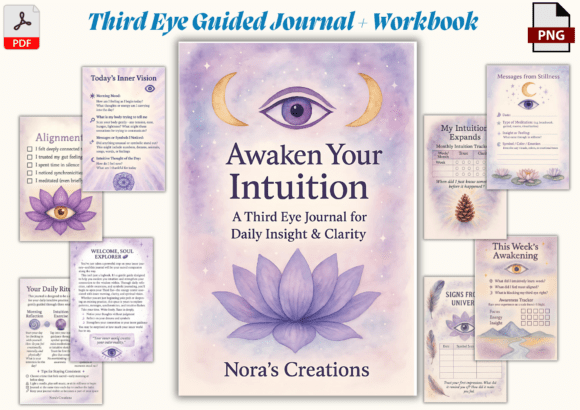
At first glance, it’s a 15-page watercolour journal sized at 6x9 inches—compact enough to hold comfortably, spacious enough to breathe on the page. But its design carries deep intention. Every spread features dreamy celestial and floral motifs, hand-painted in soft, flowing watercolours. This isn’t decoration for decoration’s sake. Visual serenity primes the nervous system. When your eyes rest on gentle gradients and organic shapes, your mind naturally slows. Your breath deepens. You become more receptive—not just to words on paper, but to the subtle shifts within.
This aesthetic harmony supports what the journal does best: create a consistent, low-pressure container for intuitive practice. Unlike apps that ping and scroll, or blank notebooks that demand structure you may not yet have, the Third Eye Journal for Daily Insight meets you where you are—whether you’re new to spiritual work or have been meditating for years. Its guided framework removes guesswork without removing agency. You’re invited—not instructed. Supported—not prescribed.
How It Works: Structure That Serves Sensitivity
The journal unfolds across three intuitive layers: daily attunement, reflective depth, and embodied integration.
- Daily pages offer clean space to record intuitive hits—those gut feelings, sudden insights, or uncanny coincidences (“synchronicities,” as Carl Jung named them). A simple checkbox, a line to jot “What did I sense before I knew?”—it builds awareness through repetition, not rigour.
- Meditative prompts appear for morning and evening use. Not long scripts—just one grounded question or image-based invitation (e.g., “What colour does clarity feel like today?” or “If my third eye had a sound, what would it hum?”). These take under two minutes but anchor attention inward when your day is most fragmented.
- Interactive exercises like “Guess What’s Next” invite playful prediction—not to be right, but to notice patterns in your instinctive responses. Pair that with mantra creation prompts (“Three words my intuition wants me to carry today…”), and you begin weaving language, rhythm, and resonance into your daily rhythm.
There’s also a Third Eye Activation Checklist, not as a rigid to-do list, but as a compassionate self-audit: “Did I pause before reacting today?” “Did I honour a ‘no’ without explanation?” “Did I notice tension behind my eyebrows—and soften it?” These small acknowledgements build neural pathways of self-trust over time.
Why Format Matters—PDF, PNG, Print-Ready, Digital-Friendly
You don’t need to choose between ink and screen—the Third Eye Journal for Daily Insight arrives as both high-resolution PDF and PNG files. That flexibility is intentional. If you love the ritual of pen-on-paper, print it once and use it for weeks—or even bind multiple copies into a seasonal intuition archive. If you prefer digital journaling (using apps like GoodNotes or Notability), the PNGs allow full layering, highlighting, and handwriting with Apple Pencil or stylus—preserving the tactile intimacy of journaling without paper clutter.
This dual-format approach reflects how modern intuitive practice lives: fluidly across spaces. You might sketch symbols beside a synchronicity note during lunch, then later add voice notes or audio reflections on your phone. The journal doesn’t gatekeep—it adapts. And because it’s print-ready at 300 DPI, the watercolour textures retain their soft luminosity—no pixelation, no flatness. The art isn’t background; it’s co-facilitator.
Who Benefits Most—And Why Timing Matters
This isn’t exclusively for “spiritual people.” It’s for anyone who’s ever said:
- “I knew it was wrong—but went along anyway.”
- “I keep attracting the same kind of situation—and I’m tired of being surprised.”
- “My emotions feel loud, but my inner compass feels faint.”
- “I want to meditate—but I don’t know what to do with the silence.”
Empaths find grounding here—not by shutting down sensitivity, but by learning to distinguish *their* energy from others’. Spiritual beginners appreciate the absence of jargon; there’s no required belief system, only curiosity and willingness. Mindful souls love how seamlessly it folds into existing routines: slip a page into your yoga mat strap, tuck it beside your tea kettle, open it during your five-minute train ride home.
It also serves beautifully in specific moments: full moon rituals (track emotional shifts across lunar cycles), shadow work sessions (use the “What am I avoiding feeling?” prompt), or even pre-decision clarity—before accepting a job, ending a relationship, or moving cities. One user shared how she used the journal for 17 days before signing a lease—and noticed every intuitive “pause” aligned with structural red flags her rational mind had dismissed.
Practical Considerations Before You Begin
Before downloading or printing, consider how you’ll engage with consistency—not perfection. A common misconception is that intuitive development requires hours of daily practice. In reality, micro-moments matter most. Two minutes of writing “What did I ignore today?” builds more awareness than an hour of forced meditation while distracted.
You’ll also want to choose tools that feel resonant—not fancy, just familiar. A smooth-writing pen, a soft pencil, or even coloured pencils for symbol-drawing. No pressure to “make it beautiful.” One page might be a scribble. Another, a single word circled three times. That’s data—not decoration.
And remember: progress isn’t linear. Some weeks you’ll fill every prompt. Others, you’ll flip through and pause at a watercolour bloom, breathing quietly. That counts. The journal holds space for presence, not performance.
Real-Life Integration: Beyond the Page
The real magic happens when insights migrate off the page and into life. A client began noticing recurring numbers—11:11, 3:33—after tracking them in her Third Eye Journal for Daily Insight. Within six weeks, she started pausing each time she saw one—not to interpret, but to ask, “What am I being invited to notice *right now*?” That tiny habit shifted how she listened in meetings, responded to texts, and even chose walking routes.
Another user paired the journal with her morning tea ritual. She’d write one intuitive hunch before checking email—and over time, spotted how often her first impression (e.g., “This message feels off”) preceded evidence (a typo, a mismatched tone, a delayed reply). Her confidence in trusting that initial signal grew—not because she was “more psychic,” but because she’d given herself permission to name it, track it, and witness its accuracy.
That’s the quiet power of this tool: it turns intuition from abstract concept into lived experience—one gentle, watercolour-lined page at a time.
Your Inner Knowing Is Already Here
You don’t need to awaken your third eye—you already have one. What you *do* need is a way to hear it clearly amid the noise. The Third Eye Journal for Daily Insight offers that clarity—not as a destination, but as a daily companion. It doesn’t promise enlightenment. It offers alignment. Not certainty—but coherence. Not answers—but the courage to sit with the question, softly, sincerely, and with colour bleeding gently at the edges of the page.
Whether you’re holding it in your hands or tapping it open on your tablet, what matters most is the space you make—not just on the paper, but inside yourself. That space is where intuition breathes. Where insight lands. Where you finally remember: you’ve always known. You just needed a place to listen.