Children’s Educational Workbook Prompts: A Practical Resource for Thoughtful Curriculum Design
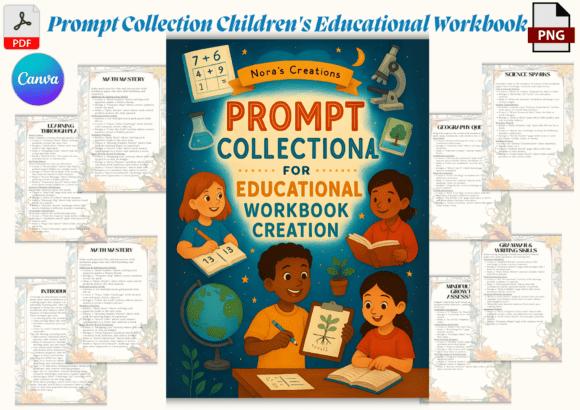
Children’s Educational Workbook Prompts is a curated, editable collection of learning activities designed specifically for creators building workbooks for children aged 4–12. Unlike generic activity generators or isolated worksheet bundles, this resource organizes prompts by subject and cognitive demand—math, reading comprehension, science, geography, grammar, critical thinking, and STEM—each aligned with common early- to middle-grade learning objectives. The 11-page Canva template (8.5 × 11 inches) delivers ready-to-customize content in both PDF and PNG formats, supporting print, digital distribution, KDP publishing, and marketplace sales like Etsy.
What Sets This Prompt Collection Apart
Many educators and independent creators start workbook projects with blank documents or fragmented online searches—scouring Pinterest for “addition worksheets,” then switching tabs to find science experiment ideas, then hunting again for age-appropriate writing prompts. Children’s Educational Workbook Prompts consolidates that effort into one coherent framework. Each prompt is intentionally open-ended enough to allow customization but structured enough to support measurable skill development—for example, a “number puzzle” prompt includes scaffolding suggestions (e.g., “use visual counters for ages 4–6; add missing-addend variation for ages 7–9”), not just the instruction itself.
The emphasis on editability matters practically: users can adjust font size for younger readers, swap out vocabulary terms to match regional spelling conventions, or replace a U.S.-centric landmark activity with one relevant to their audience—all without redesigning from scratch. That flexibility contrasts with static PDF-only resources where changes require graphic design expertise or third-party tools.
How It Compares to Other Approaches
Three broad categories of resources serve similar needs: pre-made printable worksheets, AI-generated activity lists, and full curriculum kits. Children’s Educational Workbook Prompts occupies a distinct middle ground—more intentional than AI outputs, more adaptable than finished worksheets, and more focused than comprehensive curricula.
- Pre-made worksheets (e.g., Teachers Pay Teachers downloads): Often high-quality and classroom-tested, but typically sold as finished pages. Modifying them requires editing software and may violate licensing terms. Children’s Educational Workbook Prompts avoids that constraint—it’s built for revision, not just reproduction.
- AI-generated prompts: Useful for brainstorming, but lack pedagogical sequencing, developmental appropriateness checks, or cross-subject alignment. For instance, an AI might suggest “write a story about volcanoes,” but won’t indicate whether that task suits a Grade 2 student’s writing stamina or tie it to earth science standards. This collection embeds those considerations directly into each prompt.
- Full curriculum kits: Comprehensive and standards-aligned, yet often over-resourced for workbook-specific goals. They include lesson plans, assessments, and teacher guides—valuable for classrooms, but excessive for someone designing a 40-page summer review packet or a themed activity book for resale. Children’s Educational Workbook Prompts stays lean: no fluff, no redundancy, just actionable starting points.
Strengths and Realistic Tradeoffs
A key strength lies in its balance of breadth and usability. The “Science Sparks” section, for example, doesn’t just list “plant life cycle” as a topic—it offers three distinct prompt pathways: a sequencing cut-and-paste for ages 5–7, a cause-and-effect diagramming task for ages 8–10, and a data-recording sheet for a real-world bean germination experiment suitable for homeschoolers or small-group instruction. That tiered approach supports differentiation without requiring the creator to invent scaffolds.
However, it’s not a substitute for subject-matter expertise. A user unfamiliar with grade-level math progressions may still need to verify whether a “multiplication challenge” aligns with their audience’s current scope and sequence—especially across international curricula (e.g., UK National Curriculum vs. U.S. Common Core). Similarly, while the geography prompts include map-reading practice, they assume basic familiarity with cardinal directions and scale interpretation; they don’t teach those concepts from the ground up.
The format also reflects practical constraints: PNG files preserve layout fidelity but aren’t text-editable outside Canva or compatible design tools. Users relying solely on word processors may find PDF edits limited to annotations—not structural changes. That makes it best suited for those already comfortable with lightweight design workflows.
When This Resource Fits—and When It Doesn’t
Children’s Educational Workbook Prompts works well when your goal is efficiency without sacrificing intentionality. Consider it if you’re:
- Developing a targeted workbook—like a “Summer Math Boost” for rising 3rd graders—and want prompts that reinforce specific operations while allowing room for branding and visual design;
- Creating multiple products and need consistent framing across subjects (e.g., all science prompts include a “Try This!” extension box, all writing prompts offer sentence starters);
- Designing for mixed-age groups and value prompts tagged by approximate developmental range rather than rigid grade levels;
- Selling on platforms where buyers expect polished, print-ready interiors—and you want to minimize time spent formatting individual pages.
It’s less ideal if you need:
- Standards-aligned lesson plans with pacing guides, answer keys, or assessment rubrics;
- Interactive digital functionality (e.g., drag-and-drop elements, auto-grading, audio support);
- Content translated into languages other than English;
- Highly specialized material—such as dyslexia-friendly fonts embedded by default or sensory-regulation adaptations (e.g., reduced visual clutter, tactile activity suggestions).
Practical Integration Examples
One educator used the “Geography Quests” prompts to build a 24-page “World Explorer” workbook for her after-school program. She kept the landmark match-up activity intact but replaced the provided country fact cards with locally relevant examples—adding indigenous names and pronunciation guides where appropriate. Another creator adapted the “Creative Writing Prompts” section into a series of illustrated journal pages for KDP, inserting original line art and adjusting sentence stems to encourage emotional literacy (“Describe a time you felt proud. What did your body do?”).
These adaptations succeeded because the underlying prompts were clear, modular, and grounded in observable skills—not tied to proprietary visuals or fixed narratives. That modularity also helps avoid copyright complications when sourcing clipart or photos later in production.
Making an Informed Choice
Choosing among educational resource options depends less on features alone and more on how those features interact with your actual workflow, audience needs, and long-term goals. Children’s Educational Workbook Prompts excels at reducing repetitive planning labor while preserving creative control—a meaningful advantage for solopreneurs, supplemental educators, and small publishing teams. It doesn’t promise to replace pedagogical judgment, but it does reduce the friction between idea and execution.
If your priority is speed-to-market with customizable, curriculum-aware content—and you’re comfortable making light design adjustments—the collection offers tangible time savings. If your work demands deep differentiation, accessibility compliance, or integration with learning management systems, you’ll likely need to layer in additional tools or consult subject specialists. Either way, evaluating resources like Children’s Educational Workbook Prompts alongside your specific constraints—not against abstract ideals—is what leads to sustainable, effective outcomes.