The Boots Go Splash Story: A Rainy-Day Wonder for Little Learners
There’s something quietly magical about a rainy day seen through the eyes of a toddler—puddles become oceans, raindrops transform into tiny drummers, and a pair of bright boots? They’re not just footwear. They’re passports to adventure. The Boots Go Splash Story captures that exact kind of wonder. This joyful rhyming picture book invites children ages 2–6 into a gentle, sensory-rich world where curiosity blooms with every splash—and where courage isn’t about grand feats, but about stepping outside with wide-eyed openness.
What Is “The Boots Go Splash Story” — And Why Does It Resonate?
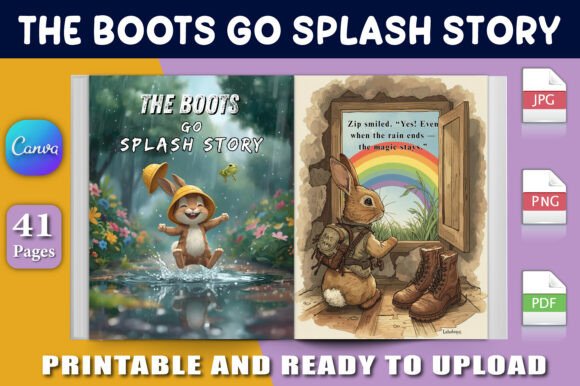
At its heart, The Boots Go Splash Story is more than a storybook—it’s an invitation. Written with lyrical simplicity and illustrated with warm, whimsical art, it follows Zip the bunny as he dons his favorite boots and ventures into a glistening, rain-washed world. Along the way, he leaps through puddles, meets a friendly frog and a slow-and-steady snail, and discovers that magic doesn’t vanish when the clouds part. It lingers—in memory, in feeling, and in the quiet joy of noticing.
This isn’t just storytelling; it’s mindful early literacy. Each rhyme flows with rhythm and repetition—ideal for developing phonemic awareness, language fluency, and listening stamina in preschoolers. But beyond literacy skills, the book nurtures emotional intelligence: Zip models curiosity without fear, presence without distraction, and delight in the ordinary. In a world increasingly saturated with screens and rapid stimuli, that kind of grounded, nature-connected joy is both rare and deeply valuable.
A Book Built for Real Life — Not Just Storytime
Parents and educators often ask: How can a picture book truly support development? With The Boots Go Splash Story, the answer unfolds across multiple layers:
- Outdoor play encouragement: The story normalizes—and celebrates—rainy-day exploration. No need to wait for sunshine. Just grab boots, open the door, and observe. Teachers use it to launch weather units, puddle science experiments, or nature journaling.
- Mindfulness scaffolding: Phrases like “Listen—the pitter-pat on leaves,” or “Watch the ripples spin and twirl” gently guide attention to sensory details—foundational practice for self-regulation and focus.
- Emotional vocabulary building: Words like “brave,” “curious,” “cozy,” and “wonder” appear organically—not as lessons, but as lived experiences. Children absorb them contextually, strengthening emotional literacy.
- Inclusive calm: The pacing is unhurried. The tone is reassuring. For neurodivergent children or those with sensory sensitivities, the rhythmic predictability and nature-based imagery offer comfort and co-regulation.
Why Rain? Why Puddles? The Deeper Significance
Rain may seem like a simple weather theme—but in early childhood development, it’s rich with symbolic and practical meaning. Rain invites observation (cloud shapes, water movement), invites cause-and-effect thinking (Why do puddles form? Where does the water go?), and supports imaginative play (puddles are lakes, rivers, or even alien planets). More importantly, rain challenges cultural assumptions that outdoor time must be “perfect”—sunshine, dry grass, zero mess.
The Boots Go Splash Story flips that script. It affirms that weather is not a barrier—it’s a collaborator. That message matters. According to research from the National Wildlife Federation, children who spend unstructured time outdoors—even in variable conditions—show stronger executive function, improved mood regulation, and deeper ecological empathy. This book doesn’t just describe puddles—it helps children belong in them.
More Than a Bunny in Boots: The Power of Character-Driven Learning
Zip the bunny isn’t a superhero. He doesn’t solve world problems or win races. His bravery lies in pausing to watch a snail glide, in asking “What’s that?” instead of walking past, in laughing mid-splash. That relatability is intentional—and pedagogically powerful.
Young children learn best through identification. When they see Zip hesitate, then try—and feel proud after—he becomes a mirror and a mentor. Unlike stories that reward only achievement, this one honors process: noticing, wondering, connecting. That aligns with modern early childhood frameworks like the NAEYC’s emphasis on social-emotional learning and inquiry-based discovery.
Practical Uses Across Settings
Whether you’re a parent reading at bedtime, a preschool teacher planning circle time, or a speech-language pathologist supporting language goals, The Boots Go Splash Story adapts beautifully:
- At home: Pair reading with sensory bins (blue water beads + plastic frogs/snails), footprint painting with washable paint, or a “rainy day scavenger hunt” (find something shiny, something bumpy, something that makes a sound).
- In classrooms: Use it to introduce weather cycles, habitats (ponds, gardens), or community helpers (meteorologists, gardeners). Its predictable rhyme pattern supports shared reading and choral response.
- In therapy: Target articulation (repetition of /b/, /p/, /s/, /l/ sounds), narrative sequencing (“First Zip puts on boots… then he sees a puddle…”), or emotion identification (“How do you think Zip feels when the frog jumps beside him?”).
- For caregivers of multilingual learners: The strong rhythm and visual cues make it highly accessible. Many families report using it to reinforce home language vocabulary around weather, animals, and actions (“splash,” “hop,” “glide”).
Common Misconceptions — Clarified
Some assume picture books like this are “just for fun” or “too simple” for meaningful learning. That’s a misconception. Early literacy isn’t only about decoding words—it’s about building background knowledge, vocabulary depth, narrative comprehension, and emotional resonance. Rhyme, repetition, and rhythm are not decorative flourishes; they’re cognitive tools that strengthen neural pathways for memory and language acquisition.
Others worry that focusing on “small moments” undermines ambition. But research from Harvard’s Center on the Developing Child shows that foundational skills—like attention control, empathy, and flexible thinking—are cultivated precisely through everyday, low-stakes interactions: watching rain, sharing a laugh over a splash, naming feelings aloud. These aren’t distractions from “real learning.” They are real learning—woven into the fabric of daily life.
Choosing Books with Intention
With thousands of children’s titles published yearly, how do you spot ones that truly support growth? Look for these markers—many present in The Boots Go Splash Story:
- Authentic voice: Language that respects children’s intelligence without talking down.
- Visual-text harmony: Illustrations that extend the story—not just repeat it—offering new details to discuss.
- Emotional honesty: Characters who feel real, not perfect—curious but sometimes unsure, joyful but also reflective.
- Open-ended invitations: Stories that end not with closure, but with lingering warmth—inviting questions, re-reads, and personal connections.
Final Thought: Magic That Stays
The last line of The Boots Go Splash Story reads: “Even when the rain ends—the magic stays.” That’s not poetic license. It’s neuroscience, pedagogy, and heart speaking in unison. The magic stays because the child remembers the sound of rain on boots. Because they recall how a snail’s trail glistens. Because they felt safe enough to wonder—and that feeling becomes part of who they are.
In choosing this book, you’re not just selecting a story. You’re planting seeds—for resilience, for reverence, for the lifelong habit of finding wonder, one splash at a time.