Transform the Way You Learn Calculus with the Calculus Workbook
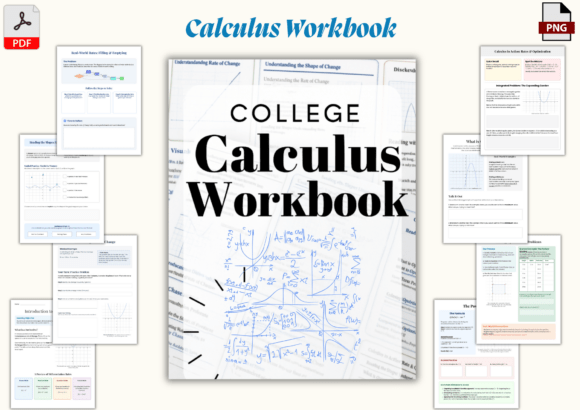
Calculus isn’t just about formulas and derivatives — it’s the language of change. From tracking the growth of a startup’s user base to modeling climate patterns or designing safer roller coasters, calculus powers decisions across science, engineering, economics, and everyday life. Yet for many learners, it remains intimidating — buried under abstract notation, dense textbooks, and fragmented explanations. That’s where the Calculus Workbook (8.5 x 11 inches) steps in: a thoughtfully crafted, printable PDF PNG study companion designed not to replace understanding — but to deepen it.
Why This Workbook Changes the Learning Experience
Traditional calculus resources often assume prior fluency in algebraic manipulation or visual reasoning — leaving gaps that widen over time. The Calculus Workbook bridges those gaps with intentionality. Created by Nora’s Creations, it merges pedagogical clarity with modern academic design — prioritizing readability, conceptual scaffolding, and real-world resonance. At its core, this isn’t just another problem set. It’s a learning architecture: one that invites curiosity, rewards persistence, and makes “aha” moments feel earned — not elusive.
What Makes It Different — and Why It Works
- Visual-first explanations: Concepts like limits, continuity, and optimization aren’t just defined — they’re illustrated. Think annotated graphs showing how a function behaves *as inputs approach a value*, or side-by-side diagrams comparing instantaneous vs. average rates of change. These aren’t decorative — they’re cognitive anchors.
- Step-by-step guided lessons: Each topic unfolds incrementally. For example, differentiation begins not with the power rule, but with the intuitive idea of slope as a changing rate — then builds to formal definitions, notation, and application — all on the same page.
- Real-world grounding: A section on optimization doesn’t stop at “find the maximum volume of a box.” Instead, it connects to designing cost-efficient packaging for e-commerce brands — complete with constraints like material weight and shipping dimensions.
- Strategic practice design: Problems progress deliberately: from identifying key features in a graph, to computing derivatives with guided prompts, to interpreting results in context (e.g., “If f(t) represents battery charge over time, what does f’(3) tell you?”).
Who Benefits — and How
The Calculus Workbook meets learners where they are — whether that’s a high school student encountering limits for the first time, a college freshman reviewing for AP Calculus BC, or an adult returning to math after years away. Its flexibility makes it equally valuable for educators building lesson plans or tutors tailoring support.
For Students
It cuts through overwhelm. Instead of flipping between textbook chapters, online videos, and handwritten notes, learners have one cohesive resource — organized, annotated, and ready for active use. The 8.5 x 11 inch layout provides generous space for margin notes, sketches, and self-explanation — proven techniques for long-term retention. And because it’s available as both printable PDF and PNG, students can annotate digitally using tablets or styluses, or print and highlight by hand.
For Teachers & Tutors
This workbook serves as a ready-to-deploy supplement — no prep required. Use individual pages as warm-up activities, scaffolded homework assignments, or small-group discussion prompts. The clean, uncluttered design ensures accessibility for diverse learners, including those with visual processing preferences. Many educators integrate pages directly into LMS platforms or project them during live instruction to walk through visual breakdowns in real time.
For Self-Learners & Lifelong Learners
Calculus isn’t only for STEM majors. Data analysts use derivatives to interpret trend acceleration; entrepreneurs apply marginal analysis to pricing strategy; even artists explore parametric curves in generative design. The workbook’s emphasis on interpretation — not just computation — helps non-traditional learners see relevance beyond exams. Its self-paced structure respects individual rhythm, while built-in checkpoints (like quick “check your understanding” prompts) provide immediate feedback.
Demystifying Common Misconceptions
A frequent barrier to calculus mastery is misunderstanding its purpose. Some assume it’s purely theoretical — “something mathematicians do.” In truth, calculus is profoundly practical. Consider these clarifications:
- Misconception: “Limits are just about ‘what happens when x gets really close.’”
Reality: Limits define continuity, enable derivative definitions, and underpin integral approximations — making them the foundation for modeling anything that changes smoothly (e.g., drug concentration in blood over time). - Misconception: “Derivatives only measure slope.”
Reality: They quantify sensitivity — how a small change in input affects output. That’s essential in machine learning (gradient descent), finance (delta hedging), and public health (infection rate modeling). - Misconception: “Optimization problems are artificial textbook exercises.”
Reality: Every time a ride-share app assigns drivers to minimize wait time *and* maximize earnings, it’s solving a multivariable optimization problem rooted in calculus principles.
Designed for Clarity — Not Just Content
Good educational design reduces cognitive load so the mind can focus on meaning. That’s why every page of the Calculus Workbook follows evidence-informed principles:
- Consistent visual hierarchy: Headings, diagrams, and practice boxes use intentional spacing and typography — guiding the eye without distraction.
- Precision in language: Definitions avoid jargon unless explicitly introduced and unpacked (e.g., “continuous” appears alongside three clear conditions — each with a visual counterexample).
- White space as pedagogy: Ample margins and breathing room prevent visual fatigue — especially important during extended study sessions.
- Print-optimized formatting: Crisp lines, high-contrast text, and scalable vectors ensure clarity whether printed on home inkjet or viewed on a tablet.
More Than a Workbook — A Learning Companion
At 33 pages, it’s concise by design. Unlike encyclopedic references, it focuses on high-leverage concepts — the ones most frequently tested, applied, and misunderstood. It includes quick-reference formula sheets *with context*: not just “∫xⁿ dx = xⁿ⁺¹/(n+1) + C,” but also “When might you use this? → Finding total distance traveled from velocity data.”
And because it’s created by Nora’s Creations — a studio grounded in both classroom experience and design thinking — every element reflects deep empathy for the learner’s journey. There’s no hidden agenda, no upsells, no filler. Just clarity, care, and craft — delivered instantly upon purchase.
Start Your Calculus Journey With Confidence
Learning calculus shouldn’t mean choosing between rigor and accessibility — or between theory and application. The Calculus Workbook proves those don’t have to be trade-offs. Whether you’re preparing for AP exams, supporting a student’s growth, or exploring math out of pure curiosity, this resource offers a steady, supportive path forward.
With its blend of visual storytelling, guided practice, and authentic context, it transforms calculus from a gatekeeper subject into a gateway — opening doors to deeper scientific literacy, sharper analytical thinking, and more informed decision-making in an increasingly complex world.
Download the Calculus Workbook today — print it, annotate it, teach with it, or study alongside it. Because mastering calculus isn’t about memorizing rules. It’s about learning to see change — clearly, confidently, and completely.