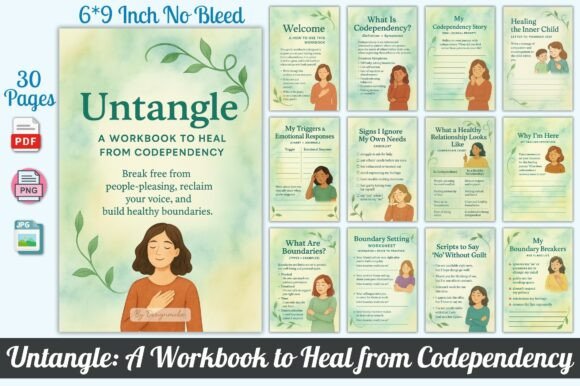
A Workbook to Heal from Codependency
If you’ve ever canceled plans with yourself to say “yes” to someone else—or felt physically anxious when you set a boundary—you’re not broken. You’re likely navigating codependency: a pattern of putting others’ emotions, needs, or approval ahead of your own, often at the cost of your energy, clarity, and sense of self. A Workbook to Heal from Codependency—titled Untangle—isn’t another dense psychology textbook or vague self-help manifesto. It’s a quiet, grounded companion for people who are ready to stop outsourcing their worth and start listening to what their inner voice has been trying to say for years.
When Life Feels Like an Emotional Relay Race
Codependency doesn’t always look like dramatic rescuing or caretaking. Sometimes it shows up in quieter, more familiar ways:
- You rehearse conversations in your head before sending a text—wondering if it sounds “too demanding” or “not grateful enough.”
- Your mood shifts depending on whether someone responded quickly—or seemed “okay” after your last interaction.
- You feel guilty saying “no,” even when you’re exhausted, overwhelmed, or simply don’t want to.
- You’ve lost track of what *you* actually enjoy—not what you think you *should* like, or what makes someone else comfortable.
These aren’t personality flaws. They’re learned survival strategies—often rooted in childhood family dynamics, long-term caregiving roles, high-stress relationships, or environments where love felt conditional. A Workbook to Heal from Codependency meets you right there: in the grocery line, on your lunch break, or curled up on the couch after a day spent managing everyone else’s emotional weather.
Real People, Real Moments Where Untangle Fits In
After a breakup that left you questioning your identity: When a relationship ends—and you realize you haven’t made a solo decision about your hobbies, wardrobe, or weekend plans in years—the workbook’s “Who Am I Without This Role?” journaling prompts help gently rebuild self-recognition, one honest sentence at a time.
While caring for aging parents: Many adult children find themselves slipping into “responsible child” mode—overlooking their own limits while managing doctors’ appointments, medications, and unspoken family expectations. The Boundary Check-In Worksheets offer low-pressure ways to test small boundaries (“I’ll call back after dinner”) and notice how your body responds—not just what others say.
In recovery from people-pleasing at work: If you’ve stayed late to fix a colleague’s mistake, apologized for asking for clarification, or avoided speaking up in meetings—even when you knew the answer—the Inner Voice vs. Outer Noise section helps separate genuine accountability from chronic self-doubt.
For therapists and coaches: While A Workbook to Heal from Codependency is designed for independent use, many mental health professionals integrate its reflection prompts and self-assessments into sessions—especially with clients who benefit from concrete, nonclinical language and gentle scaffolding between appointments.
What Makes This Workbook Different (and Why That Matters)
Not all healing tools land the same way—and that’s okay. Here’s what users consistently notice about Untangle:
- It doesn’t pathologize your care. There’s no shaming language about “toxic” traits or “bad habits.” Instead, it honors how deeply human it is to seek connection—and helps you expand your capacity for both closeness *and* autonomy.
- It works with your rhythm—not against it. At 6 x 9 inches and designed as a printable PDF, it fits in a tote bag, tablet sleeve, or bedside drawer. You can spend five minutes on a guilt-reflection prompt before bed—or dive into a full Weekly Reflection on Sunday morning. No pressure to “catch up.”
- It names the invisible labor. Pages like Journaling Through Fear and Redefining Worth speak directly to feelings many struggle to name: the dread before setting a limit, the hollow relief after over-giving, the quiet grief of realizing you stopped trusting your own judgment years ago.
Things to Keep in Mind Before You Begin
This isn’t a quick-fix tool—and it’s not meant to be. Healing codependent patterns is less like flipping a switch and more like relearning how to read your own internal compass. A few gentle considerations:
- You don’t need to be “ready” to start. Many begin with just one question they keep avoiding—like “What would I do if no one else had an opinion?” That’s more than enough to open the first page.
- Discomfort may show up—and that’s useful. Some prompts invite honesty that feels tender or unfamiliar. That’s not a sign you’re doing it wrong. It’s often the first signal that something important is shifting beneath the surface.
- Digital or print? Both work. Whether you prefer typing into Goodnotes or writing by hand in a spiral notebook, the layout supports either. And because it’s a downloadable PDF, there’s no waiting, no shipping, and no subscription—just immediate access when you’re ready.
Who Might Find It Especially Helpful (and Who Might Want Extra Support)
A Workbook to Heal from Codependency resonates most deeply with people who value self-guided, reflective work—and who already sense that change begins with awareness, not overhaul. It’s especially supportive for those recovering from emotionally enmeshed families, recovering people-pleasers, empaths who feel perpetually drained, or anyone rebuilding after relational trauma.
That said, if you’re currently experiencing active abuse, severe depression, suicidal thoughts, or dissociation, this workbook is best used alongside professional support—not as a replacement. Its strength lies in gentle guidance, not crisis intervention. Think of it as the steady hand beside you—not the lifeline you hold alone.
Small Shifts, Not Grand Gestures
Healing from codependency rarely happens in epiphanies. It happens in micro-moments: choosing rest over reassurance, naming a feeling without immediately fixing it, noticing your shoulders relax *after* you say “I’ll think about it.” Untangle meets you in those moments—not with answers, but with thoughtful questions, space to pause, and quiet permission to prioritize yourself—not someday, but now.
There’s no “end point” where you suddenly become “independent” and never second-guess again. But with consistent, compassionate use, A Workbook to Heal from Codependency helps you recognize your patterns faster, respond with more choice, and slowly—gently—reclaim the quiet confidence of knowing your own mind, your own needs, and your own enoughness.