Winter Calligraphy Workbook
If you’ve ever watched snow fall while sipping hot cocoa and thought, “I’d love to write something beautiful right now”—this is the quiet, cozy spark the Winter Calligraphy Workbook was made for. It’s not a rigid course or a high-pressure tutorial. It’s a soft invitation: trace a frost-kissed “J” in January, practice looping “snowflake” in soft brush strokes, or slowly form “cozy” with intention—no prior experience needed.
What This Workbook Genuinely Offers (and What It Doesn’t)
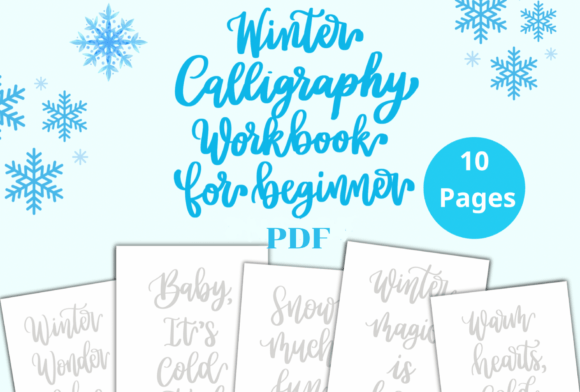
The Winter Calligraphy Workbook for Beginners is a 10-page printable digital file—PDF format, standard 8.5 x 11 inches—designed for real-life flexibility. You’ll get tracing sheets with guided pressure cues, full lowercase and uppercase alphabets built for rhythm over perfection, and festive words like “evergreen,” “mitten,” and “ember” that feel seasonal without leaning into cliché. It’s intentionally minimal: no video links, no app subscriptions, no login walls. Just clean lines, thoughtful spacing, and winter-themed lettering prompts that honor slowness as a skill—not a setback.
It’s not a certification path. It won’t turn you into a professional sign painter in a week. And it doesn’t assume you own a $200 brush pen set. That’s by design. This is for the person who bought a beginner brush pen on a whim last November, tried three times, got frustrated, and tucked it away—but still feels drawn to the idea of making letters that breathe.
Where This Workbook Fits Into Real Life (Not Just Craft Time)
For the busy parent building small rituals: Ten minutes before bedtime, print one page, grab a pencil or your favorite marker, and let your hand follow the curves of “starlight” or “cocoa.” No pressure to finish. No need to “get it right.” Just movement, focus, and the gentle satisfaction of seeing your own hand grow more confident—even if only in one letter.
For the remote worker craving tactile balance: After hours of backlit screens, this workbook offers analog grounding. Import the PDF into Procreate on your iPad, pair it with an Apple Pencil, and enjoy the haptic feedback of digital tracing—without notifications, without tabs, without the mental load of switching apps. It’s screen time that feels restorative, not draining.
For the educator or community organizer: Use individual pages as low-prep, inclusive warm-ups in after-school art clubs, senior center workshops, or library winter craft sessions. The tracing structure supports fine motor development, visual tracking, and mindful attention—especially helpful for teens navigating anxiety or adults recovering from mild hand injuries. Because the sheets are digital, you can print just what you need, when you need it—no bulk inventory, no waste.
For the small business owner or maker: Think beyond holiday cards. Practice “hand-poured,” “locally crafted,” or “small batch” in your own voice—and start using those phrases authentically in product tags, Instagram captions, or packaging notes. The workbook builds muscle memory so your brand voice feels personal, not templated.
Who Benefits Most—and How Their Needs Shape the Experience
- New calligraphers (ages 20–35): Appreciate the lack of jargon. Letters are grouped by stroke family (“entry strokes first,” “exit strokes next”), not historical classification. You learn by doing—not memorizing terms like “x-height” or “ascender line” upfront.
- Creative professionals (35–50) seeking reset: Value the seasonal framing. “Winter” isn’t just decorative—it signals permission to slow down, simplify, and prioritize texture over speed. Many report using the workbook during Sunday planning sessions, pairing lettering with goal-setting or gratitude journaling.
- Therapists and occupational practitioners: Rely on the consistent 8.5 x 11 sizing for easy integration into existing tools. The tracing density is calibrated—not too light (to avoid guessing), not too heavy (to allow for variation). And because it’s digital, you can adjust contrast or size for clients with low vision or motor coordination differences.
Practical Things to Keep in Mind Before You Begin
You don’t need special paper—but smoother text-weight or marker paper (like HP Premium32) helps prevent bleed-through if you’re using brush pens. If printing at home, check your printer’s “fit to page” setting; some default to scaling down slightly, which can shrink the guide lines just enough to throw off spacing.
On iPad? The PDF imports cleanly into Procreate, GoodNotes, or Notability. For best results in Procreate, use the “Insert > Insert Photo” workflow (not drag-and-drop), and select “Scale to Fit” to preserve line integrity. A medium-nib stylus (like the PencilGrip or Logitech Crayon) gives more control than fingertip tracing.
One gentle note: Because this is a tracing-focused workbook—not a freehand progression guide—you’ll want to pair it later with simple blank practice sheets once muscle memory starts clicking. That’s not a flaw; it’s intentional scaffolding. Like training wheels, they’re meant to come off naturally when your hand begins to remember the flow.
Strengths That Feel Like Quiet Wins
The biggest strength isn’t technical—it’s emotional resonance. Words like “frost,” “lantern,” and “hearth” aren’t just festive filler. They carry weight, warmth, and invitation. You’re not practicing “A B C”—you’re practicing presence. And because each page stands alone, you can return to “icicle” on a gray Tuesday or “wreath” the morning before a friend’s baby shower—no catching up, no guilt.
It also sidesteps a common beginner trap: overchoice. No 17 font variations. No competing styles. Just one cohesive, winter-soft aesthetic—so your brain isn’t toggling between decisions, but settling into motion.
A Note on Limits—So You Can Choose With Clarity
This isn’t a workbook for advanced flourishing or pointed pen techniques. If you’re already comfortable with thick-thin contrast and want to dive into ornamental swashes or copperplate drills, this sits earlier on the learning curve—and that’s its purpose. Likewise, it doesn’t include video demos or live feedback. Its power lies in accessibility, repetition, and calm consistency—not real-time correction.
And while the PDF is optimized for both print and digital use, very high-resolution displays (like newer M-series iPads) may show faint pixelation when zoomed past 200%. For most users, it’s imperceptible—but if ultra-fine line clarity is non-negotiable for your workflow, consider testing a single page first.
In short: the Winter Calligraphy Workbook meets you where you are—not as a student needing fixing, but as a person holding space for something tender, seasonal, and quietly expressive. Whether you’re rediscovering handwriting after years of typing, gifting yourself ten minutes of unhurried focus, or simply wanting to send a card that feels like a hug on paper—this is where it begins. Gently. Warmly. One traced letter at a time.